Planning a driving trip across the Channel with your steering wheel knob fitted? Here’s the short answer: Germany is the country to watch — spinner knobs there are effectively restricted to disabled drivers with an officially registered adaptation. France and Spain are less clear-cut: we could not find a definitive official position for either country, so check locally before you travel.
Since Brexit, your UK driving licence covers you for short visits to the EU, but your car — and anything attached to its steering wheel — has to follow local rules. The rules that apply at home are covered in our guide to steering wheel knob laws in the UK and what every driver needs to know in 2026. This article looks at what changes once you cross the water. This is general guidance, not legal advice — when in doubt, ask locally before you drive.
Germany: the strict one — leave the knob off
Germany takes the hardest line of the three countries in this guide. The consistent picture from German sources is that a steering wheel turning knob (Lenkraddrehknopf) is treated as a disability vehicle adaptation, not a general motoring accessory.
German mobility-adaptation specialists describe the turning knob as equipment for physically disabled drivers: product documentation from rehab vehicle converters notes that the knob must be removable without tools, and that a vehicle with one fitted may only be driven by someone with the corresponding restriction entered on their driving licence (in the context of Germany’s road traffic licensing rules, the StVZO). Disability press material from manufacturers such as Opel describes the turning knob in the same way — a detachable aid for one-handed steering, designed to be removed when a non-disabled driver takes the wheel.
The practical upshot for a UK visitor: unless you are a disabled driver travelling with a formally registered adaptation, do not drive in Germany with a spinner knob fitted. Remove it before you cross the border and refit it when you return to the UK or to a less restrictive country. If you do use a knob as a registered disability aid, carry whatever adaptation or medical documentation you hold, and be ready to show it if you are stopped.
France: no official ban we could find — but no clear green light either
France is the murkiest of the three. We could not find a definitive official position — no statement from the French authorities specifically addressing steering wheel knobs for general use — so treat everything below as the best available picture rather than a ruling.
French motoring sources lean permissive. One French buyer’s guide states that nothing prohibits the use of a steering wheel ball (boule de volant) on any type of road, while noting that for drivers with a medically diagnosed disability the device is treated as an adapted control with additional requirements. A French retailer’s FAQ similarly describes use as permitted provided the knob does not compromise driver safety or interfere with airbag operation.
One dissenting source — an affiliate-style parts comparison site — claims the accessory is now banned in France on safety grounds, but it offers no official citation, so we would not rely on it.
Our reading: there is no clear French ban on the books that we could verify, and French motoring sources generally describe everyday use as tolerated. But because we could not verify an official position, check locally before travelling — for example with a motoring organisation or the hire company if you are renting — rather than assuming you are in the clear.
Spain: recognised as a disability adaptation — and modifications need paperwork
Spain’s position is clearer for disabled drivers and unclear for everyone else.
Spanish guidance on driving licences for people with disabilities lists steering wheels with a knob (volantes con pomo) among the recognised vehicle adaptations, which must be validated by the ITV (Spain’s equivalent of the MOT) before the vehicle is used on the road. So if you are a disabled driver with a properly documented adaptation, Spain has a formal route for recognising it.
For non-disabled drivers, the picture is different. Spanish car-modification guides explain that any change affecting the steering system counts as a reforma de importancia — a significant modification — which requires homologation and registration at the ITV. A spinner knob clamped to the steering wheel plausibly falls into that category, though we could not find an official statement saying so explicitly.
Bottom line for Spain: we could not find a definitive official position on casual use by non-disabled drivers — check locally before travelling. If your knob is part of a recognised disability adaptation, bring your documentation; if it is a convenience accessory, be aware that Spain treats steering modifications as paperwork-heavy territory.
Practical tips for taking your knob across the Channel
1. Plan around the strictest country on your route. If your trip touches Germany at any point, assume the knob comes off for the German leg. Work backwards from there when planning France and Spain.
2. Choose a quick-release design. The single most useful thing you can do as a cross-border driver is fit a knob you can remove in seconds without tools. That turns “is it allowed here?” from a legal headache into a two-minute job at a service station before the border — and refitting on your return is just as quick.
3. Carry your paperwork. If you use the knob as a disability aid, bring any adaptation certificates, medical letters or licence endorsements you hold, and keep them with your driving licence, insurance documents and V5C. It costs nothing and can defuse a roadside conversation instantly.
4. Fit it securely and keep the airbag zone clear. Wherever you drive, a loose or badly fitted knob is a safety risk and an invitation to scrutiny. Make sure the clamp is tight, the knob spins freely, and nothing interferes with the airbag or your view of the instruments.
5. Think about your vehicle type. Driving a van, camper or motorhome to Europe? The rules for commercial and larger vehicles can differ from those for cars — our guide to whether spinner knobs are legal for vans and commercial vehicles in the UK is a useful starting point, though local rules still apply abroad.
6. Check hire-car terms. If you are fitting your own knob to a rental car in France or Spain, check the rental agreement first — many forbid modifications of any kind, and you could be liable for damage to the steering wheel.
Quick takeaways
- Germany: effectively restricted to disabled drivers with a registered adaptation — remove the knob before entering.
- France: no official ban we could verify, and French motoring sources lean permissive — but no definitive official position, so check locally.
- Spain: recognised as a disability adaptation (ITV-validated); casual use by non-disabled drivers has no clear official position — check locally.
- Everywhere: local rules apply after Brexit, a quick-release knob makes border crossings painless, and carrying your documentation is always wise.
Shop UK steering wheel knobs
Clamp-on spinner knobs that fit steering wheel rims about 28–40mm thick. No drilling, removable in minutes.
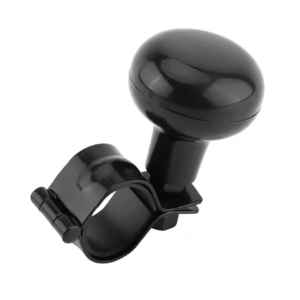
Steering Wheel Ball Spinner Knob – Black
The classic all-black steering ball with a smooth ball-bearing spin.
£14.99
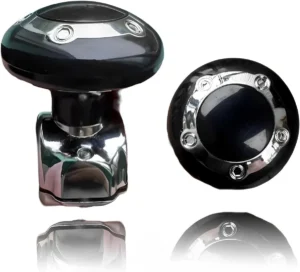
Chrome Steering Wheel Spinner Knob
Chrome-trimmed spinner knob with a metal clamp, in black or silver.
£14.99
✓ Free UK Royal Mail delivery · ✓ Dispatched within 3 working days · ✓ 14-day returns · ✓ 1-year warranty
Frequently asked questions
Can I drive through France, Spain and Germany in one trip with my knob fitted?
Not safely from a legal standpoint. Remove it before Germany at a minimum. For France and Spain, where we could not verify a definitive official position, the cautious approach is to drive without it or confirm the local position before you go.
What if I need the knob because of a disability?
All three countries recognise steering knobs as disability adaptations in some form — most explicitly Germany and Spain. Travel with your adaptation documentation and, for Germany, ensure the adaptation is formally registered on your licence. If your disability is not formally documented, get advice before travelling.
Should I tell my insurer I’m driving abroad with a knob fitted?
Check your policy wording. Many UK policies ask about modifications, and driving abroad does not remove that obligation. If in doubt, a quick call to your insurer before the trip is cheaper than an argument after an incident.
