Steering wheel knobs, also known as spinner or Brodie knobs, spark debate among UK motorists. While some find them essential mobility aids or convenient for manoeuvring, their legality often causes confusion. With evolving regulations and stricter enforcement on road safety, understanding the current legal landscape is crucial.
This comprehensive guide clarifies steering wheel knob laws in the UK for 2026. We will examine relevant legislation, including the Road Vehicles (Construction and Use) Regulations 1986, MOT rules, and guidance from the DVLA and DVSA. Whether you use a steering wheel knob for mobility or personal preference, this article ensures you stay compliant.
The Legal Landscape: Understanding UK Regulations
Drivers considering a steering wheel knob must understand its legality on UK roads. Generally, these knobs are legal if used correctly and without compromising vehicle safety or control. Specific regulations govern this.
The Road Vehicles (Construction and Use) Regulations 1986
This foundational legislation doesn’t explicitly ban steering wheel knobs. Regulation 104 mandates a driver maintain proper control of the vehicle at all times. A steering wheel knob assists in turning without altering the steering gear. Provided it’s securely fitted and doesn’t impede full control, it complies. However, improper fitting or use leading to loss of control could result in prosecution. Legality hinges on safe installation and use.
Road Traffic Act and General Driving Conduct
The Road Traffic Act 1988 prohibits driving without due care and attention or reasonable consideration for others. If a police officer deems a steering wheel knob unsafe—e.g., snagging clothing during a manoeuvre or hindering proper grip—you could face charges. The device itself isn’t illegal, but its impact on driving conduct is scrutinised.
DVLA and DVSA Guidance
The DVLA and DVSA offer practical guidance on vehicle adaptations. The DVLA focuses on medical conditions affecting safe driving. If a steering wheel knob is a mobility aid, the driver must inform the DVLA of their condition and adaptations. The DVSA, overseeing MOT testing and driving standards, doesn’t classify steering wheel knobs as illegal. They are recognised adaptations for disabled drivers, but all adaptations must be fit for purpose and safe.
Steering Wheel Knobs and MOT Tests
Many drivers wonder if a steering wheel knob affects MOT results. The MOT test ensures vehicles meet minimum safety and environmental standards.
What the MOT Manual Says
The official MOT inspection manual states that a steering wheel spinner knob won’t cause an MOT failure if it’s securely attached and doesn’t damage the steering wheel or interfere with its operation. The DVSA clarifies it’s not a testable item as it’s additional equipment.
Common Misconceptions
A common misconception is that non-factory-fitted steering wheel knobs are illegal. This is false; many legitimate adaptations are aftermarket. Safety and security are paramount, not originality. Another myth suggests knobs are only legal for disabled drivers. While primarily mobility aids, no law prohibits able-bodied drivers. However, able-bodied drivers must ensure the knob doesn’t impede safe driving, unlike disabled drivers, who have medical justification.
Specific Use Cases: Disabled Drivers
For many disabled drivers, a steering wheel knob is vital, enabling one-handed steering for those with limited arm mobility or who use hand controls.
Adaptations for Mobility
Steering wheel knobs are among the most prescribed driving adaptations in the UK, available in various forms like standard knobs, tetra grips, and steering balls with integrated controls. As a mobility aid, they are often part of a broader system, designed and installed by specialist mobility companies for safety and compliance.
Assessment and Licensing
Disabled drivers needing a steering wheel knob must undergo assessment at a Mobility Centre to evaluate capabilities and recommend adaptations. Post-installation, the DVLA must be notified. A restricted driving licence may be issued, specifying required adaptations. Driving without these, or using them incorrectly, can invalidate the licence and insurance.
Potential Risks and Best Practices
Despite their benefits, steering wheel knobs carry risks. Improper use or installation can lead to dangerous situations.
Safety Considerations
Catching on clothing, causing sudden, unintended steering input and loss of control, is a primary safety concern. In a collision, a protruding knob can cause significant injury, especially without an airbag or if it deploys incorrectly. Some modern knobs feature quick-release mechanisms for enhanced safety.
Installation and Maintenance
Proper installation is paramount. A steering wheel knob must be securely clamped to the rim. A loose knob can slip during a manoeuvre, leading to loss of control. Drivers should regularly inspect the device for security and smooth operation. Consider the steering wheel material; some knobs can cause damage if clamped too tightly. A protective rubber shim can prevent this.
Conclusion
In 2026, steering wheel knobs will remain legal and vital for many UK drivers. Under the Road Vehicles (Construction and Use) Regulations 1986 and the Road Traffic Act, they are permitted if they do not compromise driver control or pose a safety risk. For disabled drivers, they are an essential tool for independence. For able-bodied drivers, their use is legal but requires careful safety consideration. Ensuring secure fitting, proper maintenance, and responsible use is key to staying safe and compliant on UK roads. Always consult a mobility specialist or the DVLA if unsure about suitability or legality.
Shop UK steering wheel knobs
Clamp-on spinner knobs that fit steering wheel rims about 28–40mm thick. No drilling, removable in minutes.
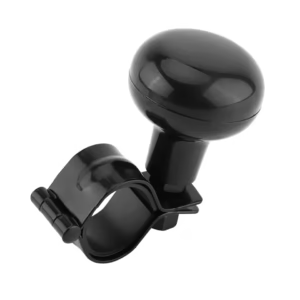
Steering Wheel Ball Spinner Knob – Black
The classic all-black steering ball with a smooth ball-bearing spin.
£14.99
View knob →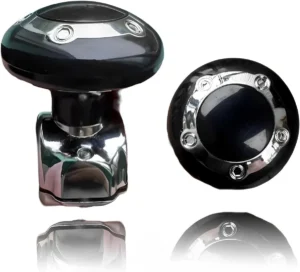
Chrome Steering Wheel Spinner Knob
Chrome-trimmed spinner knob with a metal clamp, in black or silver.
£14.99
View knob →✓ Free UK Royal Mail delivery · ✓ Dispatched within 3 working days · ✓ 14-day returns · ✓ 1-year warranty
Frequently Asked Questions (FAQs)
Are steering wheel knobs illegal in the UK?
No, steering wheel knobs are generally legal in the UK, provided they are securely fitted and do not compromise the driver’s control of the vehicle or pose a safety risk.
Will a steering wheel knob fail my MOT?
No, a steering wheel spinner knob will not cause an MOT failure on its own. It is not a testable item, as long as it is securely attached and does not damage the steering wheel or interfere with its operation.
Can I use a steering wheel knob if I’m not disabled?
Yes, there is no specific law prohibiting able-bodied drivers from using them. However, you must ensure it does not impede your ability to drive safely, as you do not have the medical justification that disabled drivers do.
Where can I find official guidance on steering wheel knobs?
Official guidance can be found on the websites of the Driver and Vehicle Licensing Agency (DVLA) and the Driver and Vehicle Standards Agency (DVSA). For disabled drivers, Mobility Centres provide assessments and recommendations.
