Steering wheel knobs, often colloquially known as ‘brodie knobs’ or ‘suicide knobs’, have a long and somewhat controversial history. Once a common aftermarket accessory, their legality has become a frequent point of confusion for drivers across the United Kingdom. Many assume these devices are outright banned, conjuring images of dangerous driving or immediate MOT failures. But what does UK law actually say about these steering aids? This comprehensive guide aims to bust the myths, delve into the relevant legislation, and provide a definitive answer for UK motorists.
Understanding the UK Legal Landscape
To ascertain the legality of steering wheel knobs, it’s essential to examine the relevant legislation and guidance governing vehicle use and modifications in the UK. Unlike some other jurisdictions, the UK does not have a law that explicitly prohibits all drivers from fitting or using a steering wheel knob.
The Highway Code and Driver Control
The Highway Code, while not legislation itself, provides crucial guidance on safe driving practices, and its rules can be used in court to establish liability. Rule 103, for instance, states that drivers “must be able to control their vehicle safely”. This overarching principle is key. If a steering wheel knob, or any other modification, impairs a driver’s ability to maintain full control of their vehicle, then its use could be deemed illegal under broader road safety regulations. The emphasis is always on the driver’s capability to steer, manoeuvre, and react effectively in all driving conditions.
The Road Traffic Act 1988
The Road Traffic Act 1988 is the primary piece of legislation governing road safety in the UK. While it doesn’t mention steering wheel knobs directly, several sections are relevant to their use. For example, Section 3 of the Act addresses “careless, and inconsiderate, driving”, stating that a person is guilty of an offence if they drive a mechanically propelled vehicle on a road or other public place without due care and attention, or without reasonable consideration for other persons using the road or place. If a steering wheel knob were to cause a driver to lose control or drive carelessly, this section could be invoked. Similarly, Section 2 covers “dangerous driving”, which applies if the way a person drives falls far below what would be expected of a competent and careful driver and it would be obvious to a competent and careful driver that driving in that way would be dangerous.
DVSA and Vehicle Safety Regulations
The Driver and Vehicle Standards Agency (DVSA) is responsible for setting standards for driving and vehicle safety. Their guidance, particularly concerning vehicle construction and use, is critical. The general consensus, supported by information from various mobility aid suppliers and motoring organisations, is that steering wheel spinner knobs are generally permitted under DVSA rules. There is no specific DVSA regulation that outlaws them for general use. However, any modification must not compromise the vehicle’s safety or the driver’s control. The DVSA’s focus is on ensuring vehicles are roadworthy and safe to operate.
MOT Rules and Steering Wheel Modifications
One of the most common concerns regarding steering wheel knobs is their impact on the MOT (Ministry of Transport) test. Many drivers fear an automatic failure. However, a steering wheel spinner knob will not cause an MOT failure on its own. It is not listed as a specific inspection item that would lead to a pass or fail. The MOT test primarily checks the overall condition and safety of the vehicle, including the steering system. Inspectors will ensure the steering wheel is secure, not excessively worn, and free of dangerous protrusions that could cause injury in an accident. If the knob is securely fitted, does not impede safe steering operation, and does not present a sharp or dangerous edge, it is unlikely to be an issue during an MOT. The key is that the modification must not render the steering system unsafe or dysfunctional.
Steering Wheel Knobs for Disabled Drivers
It is crucial to highlight that steering wheel knobs are widely recognised and accepted as essential mobility aids for many disabled drivers. For individuals with limited hand dexterity, arm strength, or who drive one-handed, these devices provide significant assistance in steering, making driving possible and safer. In these cases, the DVSA and other regulatory bodies view them as legitimate adaptations. When fitted as part of a vehicle adaptation for a disabled driver, their legality is unequivocally accepted, and they are considered a necessary modification to facilitate safe driving.
Police and Enforcement: What to Expect
While steering wheel knobs are not explicitly illegal, police officers have discretion to stop a driver if they believe the vehicle is being driven in an unsafe manner or if a modification poses a hazard. If an officer observes a driver struggling to control their vehicle due to a poorly fitted knob, or if the knob itself is deemed to be a dangerous protrusion, they could issue a warning, a fixed penalty notice, or even prosecute under the Road Traffic Act 1988 for offences such as careless driving. The focus of enforcement will always be on the driver’s ability to maintain proper control and the overall safety of the vehicle. It is therefore paramount that any steering wheel knob is fitted correctly and does not interfere with the driver’s ability to steer effectively.
Court Precedents and Interpretations
There are no widely publicised court precedents in the UK specifically banning steering wheel knobs for general use. Cases involving such devices typically fall under the broader categories of careless or dangerous driving, where the knob might be a contributing factor to a loss of control, rather than the sole reason for prosecution. The legal system would assess whether the use of the knob, together with other factors, constituted a breach of the Road Traffic Act. This reinforces the idea that the device’s legality hinges on its safe and responsible use, rather than on its mere presence.
Best Practices and Recommendations
Given the nuances of UK law and guidance, here are some best practices for drivers considering or using a steering wheel knob:
- Ensure Secure Fitting: The knob must be securely attached to the steering wheel and not wobble or come loose during driving. A poorly fitted knob is a hazard.
- Maintain Full Control: The primary consideration is always your ability to maintain full and safe control of the vehicle at all times. If the knob hinders this, it should not be used.
- Consider Your Vehicle: Ensure the knob does not interfere with airbags, horn operation, or other essential steering wheel controls.
- Quality Matters: Invest in a high-quality, reputable steering wheel knob designed for automotive use.
- Disabled Drivers: If you are a disabled driver, ensure the knob is fitted as part of a professional adaptation and is suitable for your specific needs.
- Regular Checks: Periodically check the knob’s fitting and condition, especially before an MOT.
Shop UK steering wheel knobs
Clamp-on spinner knobs that fit steering wheel rims about 28–40mm thick. No drilling, removable in minutes.
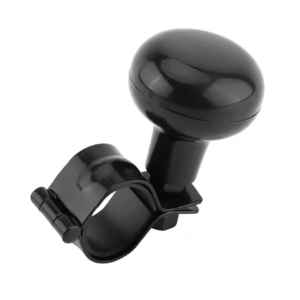
Steering Wheel Ball Spinner Knob – Black
The classic all-black steering ball with a smooth ball-bearing spin.
£14.99
View knob →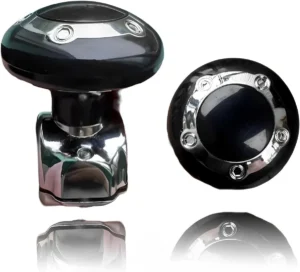
Chrome Steering Wheel Spinner Knob
Chrome-trimmed spinner knob with a metal clamp, in black or silver.
£14.99
View knob →✓ Free UK Royal Mail delivery · ✓ Dispatched within 3 working days · ✓ 14-day returns · ✓ 1-year warranty
Conclusion
In conclusion, the notion that a steering wheel knob is inherently illegal in the UK is largely a myth. There is no specific legislation prohibiting their use by all drivers. However, their legality is conditional upon the driver’s ability to maintain safe and proper control of their vehicle, as stipulated by the Highway Code and the Road Traffic Act 1988. For disabled drivers, these devices are recognised and accepted as legitimate and often essential mobility aids. While they will not automatically fail an MOT, they must be securely fitted and not compromise the steering system’s safety. Ultimately, responsible use, secure fitting, and ensuring the device enhances rather than hinders vehicle control are the keys to avoiding legal issues. When in doubt, always prioritise safety and consult with mobility specialists or motoring organisations for personalised advice.
