Let’s start with the obvious objection, because it’s the first thing every sceptic says — and honestly, it’s a fair one.
You’ve seen the knobs. A little handle clamped onto a steering wheel, spinning freely so you can steer with one hand. Your immediate reaction might be: why would I buy one of those? I already steer one-handed all the time — I just use the heel of my hand, or palm the wheel through the easy bits.
That instinct is worth listening to. A steering wheel knob isn’t a gadget everyone should own. Some drivers will get real value from one, and plenty won’t. This article is the honest filter: five questions to work through before you spend a penny. If you answer “no” to all of them, walk away and save your money.
1. Can you already steer comfortably with one hand?
This is the big one. Loads of drivers steer one-handed with the heel of their hand or a loose palm grip on the straight bits and during gentle manoeuvres — and if that works for you without effort or strain, a knob is solving a problem you don’t have.
A knob’s advantage isn’t that it lets you steer one-handed (you already can). It’s about control during bigger wheel movements. Palming works fine when the wheel barely turns. When you’re reversing into a tight parking space, threading through a narrow multi-storey, or doing a full lock-to-lock turn, the heel of your hand slips and re-grips constantly. A knob gives you a fixed, spinning grip point through the whole rotation — one smooth pull instead of repeated shuffling.
So ask yourself: do you fumble, regrip, or wrestle the wheel during low-speed manoeuvres? If no, you’re not the customer. If parking and reversing genuinely annoy you — hand slipping, wrist at an awkward angle, wheel whipping through your palm — keep reading.
2. Do you drive long hours or spend most of your time at low speed?
Here’s an uncomfortable truth about knobs: for ordinary motorway and A-road driving, most people don’t need one. Two hands, normal grip, done. The knob’s home territory is slow-speed, high-repetition steering — exactly the driving that wears you out in a different way.
Taxi and private-hire drivers, delivery drivers, couriers, driving instructors, farmers, and anyone who parallel parks twenty times a day live in that territory. If your working day is dozens of three-point turns, loading-bay reverses, and tight yard shunts, the cumulative grip-and-release cycle adds up. That’s also why knobs are standard issue on forklifts and tractors — machines built for exactly this kind of constant low-speed turning.
The honest version: if you drive 20 minutes to the station, park in a spacious car park, and drive home again, a knob is a novelty purchase. If steering is genuinely part of your job, it’s a tool.
3. Do you have grip, wrist, or shoulder issues?
This is the strongest case for a knob, and the one sceptics tend to miss. Not everyone steers from a fully working hand.
If you have arthritis, carpal tunnel, a wrist injury, tendonitis, reduced grip strength, or a missing or partially impaired hand, palming the wheel isn’t an option you “just do” — it’s the thing that’s painful. A knob converts the steering action from a gripping, twisting motion into a simple push-pull with the palm or a closed fist. For some drivers, that’s the difference between comfortable driving and dread.
The NHS runs Driving Assessment services that evaluate exactly this: how accurately and safely a person can use steering controls with limited hand function, including in dual-control cars. Some drivers are formally assessed and cleared to drive adapted vehicles one-handed — a spinner knob is a recognised adaptive driving aid in that world, not a gimmick.
Important caveats. First, if you’re driving with an injury or condition, talk to your doctor and check your position with the DVLA — you have a legal duty to notify them of anything that could affect your driving. Second, this article is not medical advice; an occupational therapist or driving assessor is the right person to judge what you need. Third, a spinner knob isn’t the only answer — steering gloves, grip aids, and power-steering adaptations all exist, and we’ve compared the options properly if you want the full picture.
4. Have you tried the alternatives first?
A fair sceptic would say: maybe you don’t need a product at all — you need a technique. Worth considering.
- Hand position and technique. Sliding your hands to 9-and-3, learning proper push-pull steering, or just practising one-handed palming through manoeuvres might fix the annoyance for free. Many of us were never taught anything beyond the basics.
- Adjust your setup. Some cars let you adjust steering weight between modes (comfort/sport). An easier steering setting costs nothing and may remove the effort you’re trying to solve.
- Other aids. If grip is the issue rather than steering generally, a pair of driving gloves with a tacky palm can do a surprising amount. If it’s a medical issue, a proper assessment beats a DIY purchase.
A knob is worth buying when you’ve established the friction is real and the free fixes didn’t resolve it — not as the first thing you try.
5. Will you actually keep it fitted — and drive sensibly with it?
Last question, and it’s the one that matters most. Be brutally honest about your own habits.
A spinner knob only helps during the manoeuvres it’s designed for: slow-speed, big wheel turns. Some drivers fit one and then keep a hand glued to it at speed — that’s worse than pointless, since you get less feel and less control than a normal two-handed grip. The old nicknames for these things — “suicide knob”, “wrist breaker” — came from an era of no airbags and no power steering, but the underlying warning still holds: it’s an aid for specific situations, not a better way to drive in general.
There’s also the fitting question. A badly fitted knob can damage the steering wheel rim (an MOT tester can fail you for a damaged rim), and some drivers find a cheap clamp-on knob works loose or slips. If you’re buying, buy a decent one, fit it properly, and check it stays put. And one more honest note: some insurers class anything attached to the steering as a modification. Checking your policy before fitting is the boring-but-sensible move — the “cover your backside” advice from drivers’ forums is actually good advice.
If the answer to “will I use it properly and maintain it” is no, don’t buy one. The drawer of discarded car gadgets doesn’t need another resident.
So — do you need one?
Here’s the honest summary:
- Probably not, if you steer one-handed comfortably already, mostly do straightforward driving, and find parking and reversing no harder than anyone else.
- Possibly yes, if you spend hours doing low-speed manoeuvres for work and your hands or wrists feel it by the end of the day.
- Quite likely yes, if a grip, wrist, or shoulder problem makes normal steering painful or difficult — with proper medical and DVLA input first.
That’s the whole pitch. We’re a shop that sells steering wheel knobs, and we’d rather sell to someone who genuinely benefits than to someone who’ll leave it in a drawer. If you’re still not sure what a spinner knob even is and how it fits, our what-is-a-steering-wheel-spinner-knob guide covers the basics. And if you’ve worked through the five questions and landed on “yes, this could actually help” — the Premium Ball Spinner Knob – Black is our straightforward all-rounder, while the Chrome Spinner Knob – Black / Silver suits drivers who want the same function with a different look.
Shop UK steering wheel knobs
Clamp-on spinner knobs that fit steering wheel rims about 28–40mm thick. No drilling, removable in minutes.
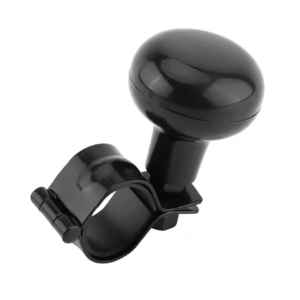
Steering Wheel Ball Spinner Knob – Black
The classic all-black steering ball with a smooth ball-bearing spin.
£14.99
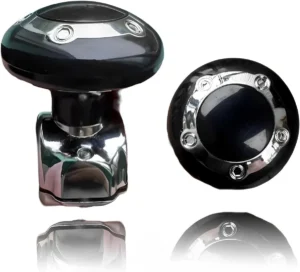
Chrome Steering Wheel Spinner Knob
Chrome-trimmed spinner knob with a metal clamp, in black or silver.
£14.99
✓ Free UK Royal Mail delivery · ✓ Dispatched within 3 working days · ✓ 14-day returns · ✓ 1-year warranty
Quick answers to the usual follow-ups
Isn’t it just easier to palm the wheel with your hand?
For gentle steering, yes — most people do it already. The knob earns its keep on big, slow wheel rotations where palming means constant slipping and regripping.
Are these knobs only for disabled drivers?
No, though drivers with limited hand function are the strongest use case. Delivery drivers, instructors, taxi drivers, and farmers use them as work tools. But if you don’t fall into any of those groups, the sceptics have a point: you probably don’t need one.
Will it affect my MOT or insurance?
A knob itself isn’t an MOT item, but if fitting it damages the wheel rim, that can be a failure. Some insurers may treat it as a modification — check before you fit. Nobody can give you a blanket answer; it depends on the insurer.
Can I use it one-handed on the motorway?
You could, but you shouldn’t make a habit of it. It’s a manoeuvring aid, not a driving-style upgrade.
