Short answer: generally yes. The DVSA expects disabled candidates to take their practical test in the same adapted vehicle they learned in — including a steering wheel knob if that is how you steer. You should declare the knob (and your disability) when you book, so the examiner is prepared and extra time can be allocated. Here is how it works in practice.
What the official rules say
The DVSA’s examiner guidance (“Carrying out driving tests: examiner guidance”, GOV.UK) is the clearest official source on this. It states that physically disabled candidates take the same test of competence as everyone else, with test requirements that are “generally the same” and the same test documents. The test is not made easier — but examiners are told to adapt their approach to the candidate, “providing the test is not undermined”.
The guidance is explicitly built around adapted vehicles. For physically disabled candidates, examiners must:
- ask about any adaptation(s) fitted to the vehicle, and
- ask how those adaptations operate in relation to the disability,
then record this in detail on the Digital Test Report and on form D255.
A steering wheel knob fits squarely into this framework. The official restriction-code list in the same guidance includes Code 40 – Modified steering, which covers a “one hand or arm operated alternative adapted steering system (e.g., steering ball or other type of steering device)”. A steering wheel spinner knob is, in function, a steering device in exactly this sense. Note that this is a classification the examiner applies, not a label you give your own knob — but it confirms the DVSA recognises steering-ball-type aids as legitimate equipment rather than test-day cheating.
Declare it when you book
This is the single most important step. DVSA’s booking service asks candidates about special requirements, and a candidate who uses a car with adaptations should say so at booking — online at GOV.UK or by phone via the DVSA booking centre (0300 200 1122). Describe the knob and your disability briefly. The details are then recorded and passed to the examiner before the test, so the adaptations aren’t a surprise on the day.
Why declare rather than just turning up? Because the guidance gives disabled candidates extra handling: more than one test period is normally allocated for an L test for a disabled person, due to the extra documentation (the D255 report must be completed for any disabled candidate with adaptations fitted, pass or fail). If you don’t declare, the examiner will still conduct the test — the guidance says so — but only one period will have been booked, and the knob will have to be explained from scratch on the day. Declaring is free, there is no extra fee for a special-needs test, and it avoids the worst-case outcome: an examiner who has never seen your setup and less time than the discussion needs.
One caveat worth stating honestly: the exact wording of the booking form’s special-requirements questions can change, and I haven’t verified the current form text on the live booking service. Whatever the current options say, the principle stands — write in plain English that you drive with a steering wheel knob fitted due to a disability, and if in doubt, book by phone and confirm with the booking centre staff. It is also worth contacting the test centre a few days beforehand to confirm your declared requirements were passed on to the examiner.
What the examiner will do on the day
Arrive early and, when you meet the examiner, be ready to explain the knob briefly: what it is, why you use it, and how it helps you steer safely. The guidance requires examiners to ask about adaptations and how they operate, so expect these questions — they’re routine, not an interrogation.
The test itself runs the same as anyone’s: eyesight check, “show me, tell me” questions, and the driving itself, including the independent-drive section. Examiners are told to accept any coping strategies you use, providing the test is not undermined. A knob does not undermine the test — it changes how you grip the wheel, not how you observe, plan, or control the car.
One practical point: if your disability affects how you operate any of the secondary controls used for the “show me” question (indicators, horn, wipers), mention this when booking as well, and be ready to demonstrate. The guidance treats the horn and wash/wipe as safety-critical — they must be operable at any time while driving.
Will the knob put a restriction code on my licence?
Possibly, and this is the part to understand before you book. If the examiner judges that you can drive only a vehicle with suitable adaptations, they indicate this on the pass certificate and enter the relevant restriction code — for a steering device, Code 40. That code then appears on the rear of your photocard licence, restricting you to vehicles fitted with the adaptation.
But if the examiner is satisfied that you are competent to drive un-adapted vehicles too, a normal pass certificate is issued with no restriction. Which outcome applies depends entirely on the examiner’s judgement of your driving on the day — no article can promise one or the other. What you can do:
- Learn and test in the setup you intend to drive afterwards. If you plan to drive with a knob permanently, test with the knob and accept that a restriction code is the likely and honest outcome.
- If you can steer safely without the knob as well, demonstrate that confidently — but never fake it. A restriction code that keeps you legal in adapted cars is far better than a licence that doesn’t reflect how you actually drive.
Either way, the D255 report goes to the DVLA (Driver and Vehicle Licensing Agency) after the test so your licence record matches the examiner’s findings.
A note on driving assessments
You don’t need a formal driving assessment to take your test with a knob — the DVSA doesn’t require an assessment report as a precondition. But if you’re unsure which adaptations you need, or whether a knob alone is enough, an assessment at a Driving Mobility centre is exactly what the DVSA’s guidance points candidates toward (examiners are told to refer adaptation-advice questions to the Forum of Mobility Centres). It’s worth doing before lessons start, not after you’ve booked the test.
For the wider picture — choosing a knob, fitting it, and how the law treats steering wheel knobs on UK roads — see our complete 2026 guide for disabled drivers.
Key takeaways
- You can generally take your UK practical test with a steering wheel knob fitted — the DVSA’s own examiner guidance is built around adapted vehicles.
- Declare the knob and your disability when booking (online at GOV.UK or on 0300 200 1122), so extra time is allocated and the examiner is briefed.
- On the day, explain the knob when asked — examiners are required to ask about adaptations and how they work.
- A Code 40 (modified steering) restriction may be added to your licence if the examiner judges you need the adaptation; if you’re judged competent without it, you get a normal pass.
- When in doubt about anything on this page, confirm with DVSA when booking — official guidance is what examiners follow.
Shop UK steering wheel knobs
Clamp-on spinner knobs that fit steering wheel rims about 28–40mm thick. No drilling, removable in minutes.
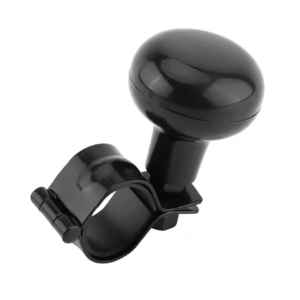
Steering Wheel Ball Spinner Knob – Black
The classic all-black steering ball with a smooth ball-bearing spin.
£14.99
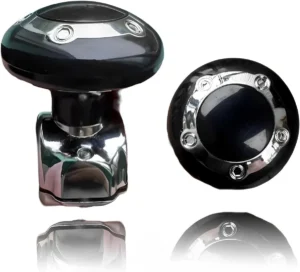
Chrome Steering Wheel Spinner Knob
Chrome-trimmed spinner knob with a metal clamp, in black or silver.
£14.99
✓ Free UK Royal Mail delivery · ✓ Dispatched within 3 working days · ✓ 14-day returns · ✓ 1-year warranty
FAQ
Do I need to tell DVSA about the knob, or can I just turn up?
Tell them when booking. It’s the safest route to extra time and a prepared examiner, and there is no extra fee for declaring.
Will the examiner fail me for using a knob?
Not for the knob itself. You’re assessed on the same driving standards as every other candidate; the knob is recorded as an adaptation, not marked as a fault.
What if I learn with a knob but want to test without it?
Then you’re testing in a different vehicle setup from the one you trained in, which examiners won’t expect and which you should have declared. Test in the car as you’ll drive it.
Does a knob count as an “adaptation” or just an accessory?
The DVSA’s Code 40 category covers steering balls and steering devices, so a knob is best treated as an adaptation for booking purposes. Declare it as such; the examiner decides how it’s recorded.
What if my test centre has never seen a knob before?
That’s exactly why you declare at booking and confirm with the test centre a few days beforehand — the guidance requires the examiner to ask about adaptations, so being upfront turns an unfamiliar setup into a routine discussion.
