If you drive for work and your employer has refused to let you fit a steering wheel knob, you may have rights under the Equality Act 2010. The short answer: if you meet the legal definition of disability, your employer has a duty to make reasonable adjustments — and permitting, or even supplying, a knob could be one. That does not make every refusal unlawful; it depends on the facts. This article explains the position in general terms only. It is not legal advice — for your situation, seek independent advice from an employment solicitor, Citizens Advice, or your trade union.
What the law actually says
Section 39(5) of the Equality Act 2010 states that “a duty to make reasonable adjustments applies to an employer.” The duty itself is set out in section 20, which contains three requirements:
- Provision, criterion or practice. Where a workplace rule — say, a fleet policy banning any vehicle modification — puts a disabled person at a substantial disadvantage compared with non-disabled people, the employer must take such steps as it is reasonable to take to avoid the disadvantage.
- Physical features. Where a physical feature puts a disabled person at a substantial disadvantage, reasonable steps must be taken to avoid it.
- Auxiliary aids. Where a disabled person would, but for the provision of an auxiliary aid, be put at a substantial disadvantage, the employer must take such steps as it is reasonable to take to provide the aid.
A steering wheel knob most naturally falls under the third requirement, as an auxiliary aid (the Act says this includes auxiliary services). It may also engage the first, if a blanket “no modifications” policy is what stands in the way.
Two further points matter. First, the duty generally applies once the employer knows — or could reasonably be expected to know — that the employee is disabled; Acas’s reasonable-adjustments guidance makes this explicit. Second, section 20(7) says the employer cannot require the disabled person to pay the employer’s costs of complying with the duty.
Do you count as “disabled” under the Act?
Section 6 defines a disabled person as someone with a physical or mental impairment which has a substantial and long-term adverse effect on their ability to carry out normal day-to-day activities. “Long-term” generally means it has lasted, or is likely to last, at least 12 months.
You do not need to regard yourself as disabled for the definition to apply, and not everyone who finds a knob helpful will meet it. What matters is the effect of the impairment — for example, reduced grip or limited arm movement that makes steering difficult — not the condition’s label.
Because the duty generally only bites where the employer knows or could reasonably be expected to know, putting your request in writing and explaining how your condition affects your driving is both good practice and legally useful.
How a steering wheel knob fits the reasonable-adjustments test
Whether the adjustment is “reasonable” is assessed on the facts, but several features of a spinner knob work in its favour:
- It is simple and low-cost. Tribunals weigh cost and practicality. A knob is inexpensive and takes minutes to fit or remove, making it hard to argue the adjustment is disproportionate.
- It targets the disadvantage directly. If your condition makes gripping and turning a standard wheel difficult, a knob addresses exactly that — which is the point of reasonable adjustments.
- Blanket policies are not enough on their own. A fleet-wide ban on modifications can itself be the provision, criterion or practice that triggers the duty. Acas stresses that adjustments are specific to the individual, so an employer that just quotes “company policy” without assessing your case is on weak ground.
None of this guarantees the outcome. An employer might propose a different adjustment that removes the disadvantage (such as reassigning duties or a vehicle with different factory-fitted controls), or raise genuine health-and-safety concerns about a particular vehicle. Those arguments must be assessed on evidence, not assumed — which is why both sides’ reasoning should be in writing.
Why a GP letter or occupational health report changes the conversation
A letter from your GP or a report from an occupational therapist can confirm that your condition should be taken seriously and recommend a steering wheel knob as a suitable aid for your driving duties. Where your employer has an occupational health department, ask to be referred for assessment.
This does not create an automatic right to the knob, and it is not a “prescription” in the legal sense. But it turns a preference into a documented, professionally supported need — much harder to dismiss without engaging with the duty. Keep copies of everything.
Practical steps if your employer says no
- Make the request in writing. Say you are requesting a reasonable adjustment under the Equality Act 2010, describe how your condition affects your driving, and explain why a knob would reduce the disadvantage.
- Attach supporting evidence. A GP letter, occupational therapist report, or occupational health assessment strengthens your position considerably.
- Ask for the reasoning in writing. Ask whether they dispute the disability, the disadvantage, or the reasonableness of the adjustment. Vague refusals are harder to defend than reasoned ones.
- Involve HR and your union. Escalate beyond your line manager, and speak to your trade union rep if you have one — unions handle adjustment disputes routinely and can guide you through the grievance procedure.
- Look into Access to Work. This government grant scheme (see gov.uk/access-to-work) can pay for special equipment or adaptations to equipment you use at work. You apply yourself — your employer cannot apply for you — removing any cost objection. It does not replace the employer’s own duty.
- Know the tribunal route, but get advice first. Acas notes that someone who does not get the adjustments they need may be able to claim to an employment tribunal, but time limits are strict. In most cases you must contact Acas for early conciliation first — check Acas’s current guidance before acting.
Honest limits: what the law does not do
- Not every refusal is unlawful. Reasonableness is judged on all the circumstances, including the employer’s resources and the nature of the role.
- The employer may offer a different adjustment. The duty is to remove the disadvantage, not necessarily to grant the exact aid requested. If an alternative genuinely works, that may satisfy the duty; if it does not, say so in writing and explain why.
- Safety arguments must be genuine. In safety-critical driving roles an employer can rely on health and safety, but it should rest on a proper assessment of the specific vehicle and aid — not a blanket assumption.
- You must still be lawfully entitled to drive. Nothing in the Equality Act overrides licensing law. If your condition is notifiable, the DVLA position still applies — see our disabled drivers’ guide to steering wheel spinner knobs for how adaptations, licensing and assessments fit together.
- Insurance still matters. Even with employer agreement, check the insurance position — our post on declaring a steering wheel spinner knob to your car insurance explains why.
Key takeaways
- Under section 39(5) of the Equality Act 2010, employers owe disabled employees a duty to make reasonable adjustments — fleet and company-car drivers included.
- A spinner knob can qualify as a reasonable adjustment, most naturally as an auxiliary aid under section 20.
- The duty generally applies once the employer knows or could reasonably be expected to know about the disability — so make your request, and its reasons, in writing.
- A GP letter, occupational therapist report or occupational health assessment turns a preference into a documented need.
- The employer cannot charge you the cost of the adjustment (section 20(7)), and an Access to Work grant may cover equipment costs anyway.
- Blanket “no modifications” fleet policies should be individually assessed — see our article on steering wheel knobs in vans and commercial vehicles for the fleet angle.
- This is general information, not legal advice. Disputes turn on their facts — get proper advice before taking formal steps.
Shop UK steering wheel knobs
Clamp-on spinner knobs that fit steering wheel rims about 28–40mm thick. No drilling, removable in minutes.
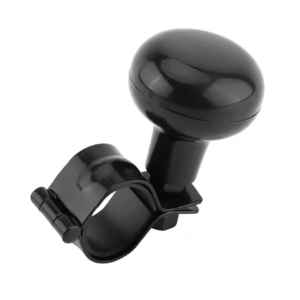
Steering Wheel Ball Spinner Knob – Black
The classic all-black steering ball with a smooth ball-bearing spin.
£14.99
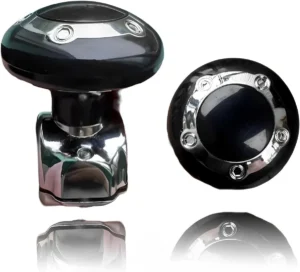
Chrome Steering Wheel Spinner Knob
Chrome-trimmed spinner knob with a metal clamp, in black or silver.
£14.99
✓ Free UK Royal Mail delivery · ✓ Dispatched within 3 working days · ✓ 14-day returns · ✓ 1-year warranty
Frequently asked questions
Can my employer ban steering wheel knobs across the whole fleet?
A blanket ban can itself be the provision, criterion or practice that triggers the duty, if it puts a disabled driver at a substantial disadvantage. The employer should assess your individual case rather than rely on the policy alone.
Do I have to disclose my condition?
There is no general obligation to disclose a disability, but the duty generally only arises where the employer knows or could reasonably be expected to know. In practice, a written request explaining the difficulty you face is how the duty is engaged.
Will a GP letter guarantee I get the knob?
No. It provides evidence and a professional recommendation, which strengthens your position considerably, but the employer still assesses reasonableness on the facts.
What if my employer offers a different adjustment instead?
The law requires the disadvantage to be addressed, not necessarily by the exact aid you requested. If the alternative genuinely removes the disadvantage, that may satisfy the duty. If it does not, explain why in writing.
