For many drivers, the steering wheel knob, often known as a “suicide knob” or “Brodie knob,” offers enhanced manoeuvrability and a distinctive aesthetic. However, in the United Kingdom, with its rigorous road safety regulations, a critical question arises: are steering wheel knobs legal?
This comprehensive guide, updated for 2026, explores the nuances of UK legislation, including the Road Traffic Act, the Driver and Vehicle Standards Agency (DVSA) stance, MOT regulations, and insurance implications, to provide a definitive answer for UK motorists.
The Road Traffic Act 1988: A General Overview
The Road Traffic Act 1988 forms the bedrock of UK road law, yet it contains no explicit mention of steering wheel knobs. Its focus is on ensuring vehicles are roadworthy and do not pose a danger. The Act mandates that all vehicles on public roads be constructed and maintained to a standard that ensures the safety of all road users. This general provision is key, as the legality of a steering wheel knob often depends on whether its presence compromises safe driving or vehicle control.
The Act also underpins the “Construction and Use Regulations,” which detail specific requirements for vehicle components. These regulations emphasise that any vehicle modification must not negatively impact its safety or control. This framework guides regulatory bodies like the DVSA in interpreting the use of such accessories.
DVSA Stance and MOT Regulations
The Driver and Vehicle Standards Agency (DVSA) is central to vehicle safety through the MOT test. The MOT inspection manual provides detailed criteria for assessing roadworthiness, particularly in Section 2, “Steering.” While steering wheel knobs are not an automatic failure, improper fitting or damage caused by a knob can lead to an MOT failure [1]. Key points include:
- Steering wheel condition: Fractures, looseness, or excessive movement between the steering wheel and column can result in a Major or Dangerous defect. A poorly installed knob could contribute to these issues.
- Modifications affecting roadworthiness: The manual specifies that “modifications likely to affect the roadworthiness of the vehicle” are unsafe. If a steering wheel knob impedes a driver’s grip, obstructs controls, or damages the steering wheel, it could fall under this category.
It is crucial to note that for disabled drivers, spinner knobs are often vital adaptive aids that enable one-handed steering. In these instances, such modifications are generally accepted, provided they are correctly installed and do not compromise safety. The DVSA recognises the necessity of these adaptations for individuals with specific mobility needs.
Insurance Implications
Beyond legal and MOT considerations, using a steering wheel knob has significant insurance implications. All vehicle modifications, even minor ones, must be declared to your insurance provider. Failure to do so can invalidate your policy, leaving you uninsured in the event of an accident.
Insurance companies assess risk based on a vehicle’s standard specification. Any deviation, such as adding a steering wheel knob, may be seen as increasing the risk of accidents or theft. Insurers might:
- Increase your premium: To reflect the heightened perceived risk.
- Refuse coverage: If the modification is deemed too risky.
- Impose specific conditions, Such as requiring professional installation.
Always contact your insurance provider before fitting a steering wheel knob to understand their policy and ensure your coverage remains valid. Transparency is essential to avoid costly consequences.
The “Grey Area” of Legality
The legality of steering wheel knobs in the UK resides in a “grey area.” They are neither explicitly prohibited nor explicitly permitted. This means enforcement often relies on law enforcement officers’ interpretation of general road safety laws.
A police officer could, at their discretion, consider a steering wheel knob an obstruction or a modification that interferes with safe vehicle control. This could potentially lead to a charge under Section 40A of the Road Traffic Act 1988, concerning vehicles in a dangerous condition. While such occurrences are rare, they underscore the importance of ensuring any accessory does not hinder safe driving.
Who Uses Steering Wheel Knobs and Why?
Steering wheel knobs have a diverse history. Historically, they were common in commercial vehicles such as lorries and tractors, aiding drivers during tight manoeuvres with large steering wheels. They facilitated quicker, one-handed steering, particularly useful in agricultural or industrial settings.
Today, their most legitimate use is as an adaptive aid for disabled drivers. For those with limited hand mobility or who use hand controls, a spinner knob is a vital tool that allows them to maintain steering control with minimal effort. These adaptations are frequently recommended and fitted by mobility specialists. A popular choice for this purpose is a ball-grip spinner knob, which is easy to grasp and rotates smoothly with minimal effort.
Some drivers also use them for convenience or aesthetic reasons. However, in these cases, the legal and safety implications are more pronounced, as the primary justification is not medical necessity. If that’s you, a discreet option like the Chrome Spinner Knob – Black / Silver blends in while keeping steering easy.
Safety Considerations and Best Practices
Safety must always be the primary concern. If you choose to fit a steering wheel knob, adhere to these best practices:
- Professional Installation: Ensure a secure fit by a qualified professional to prevent loosening or detachment.
- Airbag Clearance: Verify that the knob does not impede airbag deployment, as this could have severe consequences.
- Unobstructed Controls: The knob should not obstruct your view of the instrument panel or interfere with other steering wheel-mounted controls.
- Maintain Full Control: While a knob assists with certain manoeuvres, you must always be able to maintain full, two-handed control of the steering wheel, especially in emergencies.
- Regular Checks: Periodically inspect the knob and steering wheel for wear, damage, or looseness.
Conclusion
In conclusion, the legality of steering wheel knobs in the UK is not explicitly defined by direct prohibition. It exists within a grey area governed by broader road safety legislation and enforcement discretion. While they are accepted as essential adaptive aids for disabled drivers and have historical commercial uses, their use for mere convenience by able-bodied drivers carries significant caveats.
To ensure compliance and safety, UK motorists considering a steering wheel knob must:
- Consult the MOT manual: confirm that the installation does not create a defect that could lead to a test failure.
- Inform their insurance provider: Declare the modification to prevent policy invalidation.
- Prioritise safe installation: Ensure the knob is securely fitted and does not impede safe driving.
Ultimately, the driver is responsible for ensuring their vehicle is roadworthy and safe. When in doubt, consult relevant authorities or automotive professionals. Safe driving and adherence to regulations are paramount on UK roads.
Shop UK steering wheel knobs
Clamp-on spinner knobs that fit steering wheel rims about 28–40mm thick. No drilling, removable in minutes.
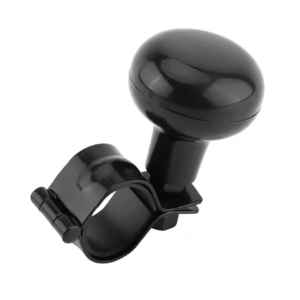
Steering Wheel Ball Spinner Knob – Black
The classic all-black steering ball with a smooth ball-bearing spin.
£14.99
View knob →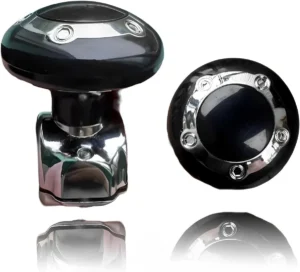
Chrome Steering Wheel Spinner Knob
Chrome-trimmed spinner knob with a metal clamp, in black or silver.
£14.99
View knob →✓ Free UK Royal Mail delivery · ✓ Dispatched within 3 working days · ✓ 14-day returns · ✓ 1-year warranty
References
[1] GOV.UK. “MOT inspection manual: cars and passenger vehicles – 2. Steering.” GOV.UK, 20 May 2018, www.gov.uk/guidance/mot-inspection-manual-for-private-passenger-and-light-commercial-vehicles/2-steering#section-2-2-1. Accessed 3 June 2026.
