Steering wheel spinner knobs, colloquially known by a colourful array of names including the ominous “suicide knob,” have a long and fascinating history intertwined with automotive evolution and cultural shifts. Once a common aftermarket accessory, particularly in an era before power steering became ubiquitous, these simple devices allowed drivers to execute rapid steering manoeuvres with a single hand. This article delves into the etymology of its various monikers, explores its historical context, and examines its legality and modern relevance within the United Kingdom.
The Origins of the Steering Wheel Spinner
Joel R. Thorp and the 1936 Patent
The concept of the steering wheel spinner knob can be traced back to Joel R. Thorp of Wisconsin, who patented the “Steering Wheel Spinner Knob” in 1936. Thorp’s invention was a doorknob-shaped handle designed to attach securely to the rim of a steering wheel. Its primary innovation was its ability to rotate independently, allowing drivers to turn the wheel more easily and quickly, especially when navigating tight spaces or performing complex manoeuvres.
Early Utility: Trucks, Tractors, and the Lack of Power Steering
In the early to mid-20th century, many vehicles, particularly heavy automobiles, trucks, and agricultural machinery, lacked power steering. This meant that turning the steering wheel, especially at low speeds or when stationary, required considerable physical effort and often a laborious hand-over-hand technique. The spinner knob offered a practical solution, enabling drivers to “crank” the steering wheel quickly and efficiently with one hand, freeing the other for operating gearshifts, radios, or other controls. This utility made them particularly popular in commercial vehicles, farm tractors, construction equipment, and even forklifts, where frequent and sharp turns are a necessity.
A Kaleidoscope of Names: Etymology and Cultural Context
Over the decades, the steering wheel spinner acquired a variety of descriptive, often evocative, names that reflect both its perceived advantages and inherent dangers, as well as the cultural attitudes of the time.
“Brodie Knob”: Reckless Stunts and a Daredevil’s Legacy
One of the earliest and most enduring alternative names is the “Brodie knob.” This moniker is widely believed to refer to Steve Brodie, a 19th-century New Yorker who famously claimed to have jumped off the Brooklyn Bridge and survived. Brodie became synonymous with reckless stunts and daredevilry. The association with the spinner knob suggests its use was linked to performing quick, sometimes audacious, steering actions, allowing drivers to “spin like a top” on slippery surfaces or execute sharp turns with a flourish.
“Suicide Knob”: The Perils of Emergency Manoeuvres
Perhaps the most infamous name, “suicide knob,” highlights the significant safety concerns associated with the device. While useful for slow, deliberate turns, the knob could become a dangerous liability in an emergency. In situations requiring rapid, precise steering corrections, the single-handed grip offered by the knob could lead to oversteering or, worse, a complete loss of control. The term implies an increased risk of an accident due to a reduced ability to control the steering wheel effectively during critical moments. Furthermore, in the event of a collision, the protruding knob could cause additional injuries to the driver, such as to the hand, wrist, or arm.
“Necker Knob”: A Byword for Romantic Endeavours
The term “necker knob” emerged from a different cultural context and was particularly prevalent in mid-20th-century American youth culture. With the ability to steer a vehicle with one hand, the other arm was freed up for more romantic pursuits, such as embracing a passenger. This name playfully, yet tellingly, reflects a period when cars were not just modes of transport but also social spaces for courtship and leisure.
“Granny Knob” and “Knuckle Buster”: Other Colourful Descriptions
Other less common but equally descriptive names include “granny knob,” possibly alluding to its perceived ease of use for older drivers or those with less strength, and “knuckle buster.” The latter name vividly describes another safety hazard: when the steering wheel rapidly unwinds after a turn, the knob can strike the driver’s knuckles, forearm, or elbow with considerable force. There were also instances where a driver’s long-sleeved shirt could become entangled with the knob, leading to a momentary loss of control while attempting to free it.
The UK Perspective: Legality, Safety, and Modern Use
In the United Kingdom, the use of steering wheel spinner knobs is subject to specific regulations and considerations, primarily concerning road safety and vehicle roadworthiness.
UK Law and Regulations: DVLA, DVSA, and MOT Rules
Unlike some jurisdictions that explicitly ban or heavily restrict their use, the legality of steering wheel spinner knobs in the UK is somewhat nuanced. The Driver and Vehicle Licensing Agency (DVLA) and the Driver and Vehicle Standards Agency (DVSA) do not explicitly prohibit their fitment in all circumstances. However, the overarching principle is that any modification to a vehicle must not compromise its safety or roadworthiness. This falls under the general requirements of the Road Traffic Act and the annual MOT (Ministry of Transport) test.
For a standard vehicle, while not an automatic MOT failure, an improperly fitted or excessively large spinner knob could be deemed to obstruct the driver’s control or pose an undue risk. Crucially, the MOT test assesses whether the steering system operates correctly and safely. If a spinner knob interferes with proper steering function, or if it presents a sharp or dangerous protrusion, it could lead to a failure. The key is that the vehicle must remain safe and controllable at all times.
Safety Concerns and Roadworthiness
The primary concern from a UK road safety perspective mirrors the origin of the “suicide knob” moniker: the potential for reduced control in emergency situations. Modern vehicles are designed with precise steering systems, and the ability to make rapid, two-handed corrections is paramount for safety. A spinner knob can hinder this, potentially leading to slower reaction times or overcorrection, especially at higher speeds. Insurers may also take a dim view of such modifications if they are not declared or if they are deemed to increase risk.
Modern Applications: Disability Aids and Commercial Vehicles
Despite the safety concerns for general use, steering wheel spinner knobs retain a legitimate and important role as a disability driving aid. For individuals with limited mobility, strength, or the use of only one arm, these devices can be essential for operating a vehicle safely and independently. In such cases, the DVLA and DVSA permit their use as a necessary adaptation. These adaptations are often fitted by specialists and are subject to assessment to ensure they meet the specific needs of the driver and do not compromise overall vehicle safety.
Furthermore, in certain commercial and agricultural contexts, such as on forklifts, tractors, and some heavy goods vehicles (HGVs), where precise, low-speed manoeuvring is common and power steering may still be less advanced or absent, spinner knobs continue to be used. Their utility in these specific environments, where the driver often needs one hand free for other controls, outweighs the general road safety concerns associated with high-speed driving.
Shop UK steering wheel knobs
Clamp-on spinner knobs that fit steering wheel rims about 28–40mm thick. No drilling, removable in minutes.
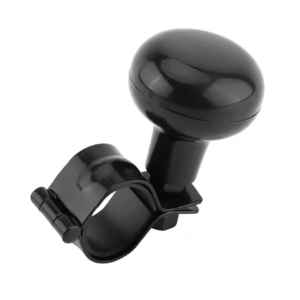
Steering Wheel Ball Spinner Knob – Black
The classic all-black steering ball with a smooth ball-bearing spin.
£14.99
View knob →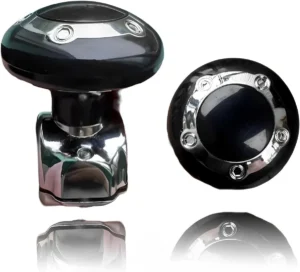
Chrome Steering Wheel Spinner Knob
Chrome-trimmed spinner knob with a metal clamp, in black or silver.
£14.99
View knob →✓ Free UK Royal Mail delivery · ✓ Dispatched within 3 working days · ✓ 14-day returns · ✓ 1-year warranty
Frequently Asked Questions
Are suicide knobs illegal in the UK?
No. “Suicide knob” is just an old nickname for a steering wheel spinner knob, and no UK law bans them. You must still stay in proper control of the vehicle at all times. Read our full answer: are steering wheel knobs legal in the UK?
Conclusion
The steering wheel spinner knob, known by its many names from the practical “Brodie knob” to the cautionary “suicide knob,” is a relic and a testament to automotive history.
Born out of necessity in an era without power steering, it evolved into a cultural icon, reflecting changing driving habits and societal norms. While its general use on modern passenger vehicles is largely discouraged due to safety implications and the prevalence of power steering, it continues to serve a vital function as a legitimate disability aid and in specific commercial and agricultural applications within the UK.
Its journey from a simple mechanical aid to a device with a complex etymology and varied legal standing underscores the dynamic relationship between technology, culture, and road safety.
