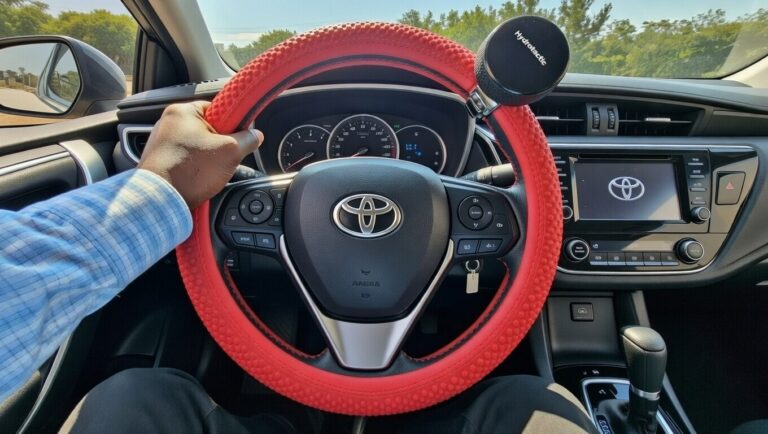
Where Should a Steering Wheel Spinner Knob Be Positioned?

You’ve decided to fit a steering wheel spinner knob. You understand the legality, the MOT position, and the insurance situation. You’ve got the knob in your hand.
Now the practical question: where on the steering wheel should it actually go?
This isn’t just about personal preference. The position of a spinner knob affects how comfortably you can steer through a full rotation, how much strain your arm and shoulder absorb over longer journeys, and whether the knob sits clear of the airbag deployment zone.
The short answer for most UK drivers in right-hand-drive vehicles: The 10 o’clock or 8 o’clock position (left side of the steering wheel) works best for most drivers. This keeps the knob on the side closest to the vehicle’s centre, away from the door, and positions it for natural wrist and forearm alignment during full-lock turns.
However, the best position for you depends on several factors — which hand you steer with, whether you drive a manual or automatic, whether you have a specific physical condition, and what type of driving you do most.
This guide covers all of it.
Understanding the Clock Positions
Before we discuss specific recommendations, let’s establish the reference system. Steering wheel positions are universally described using a clock face as viewed from the driver’s seat: Copy
- 12 o’clock — top dead centre of the wheel
- 3 o’clock — directly right (nearest the door on a right-hand drive vehicle)
- 6 o’clock — bottom dead centre
- 9 o’clock — directly left (nearest the centre console on a right-hand drive vehicle)
When this article refers to a clock position, this is the reference frame. Every position is described as seen from the driver’s seat, facing the wheel.
The Recommended Positions (And Why)
10 O’clock — The Most Common Position for UK Drivers
Best for: Right-hand drive vehicles, drivers who steer primarily with their right hand, and manual gearbox vehicles
The 10 o’clock position places the knob on the upper-left quadrant of the wheel. For a UK driver sitting on the right side of the vehicle, this means:
- The knob sits on the inboard side of the wheel (toward the centre of the car), not the door side
- The right hand grips the knob at a natural height — slightly above the centre line of the wheel, which keeps the forearm roughly horizontal and reduces shoulder fatigue
- During a full left-lock turn (the most demanding rotation in tight manoeuvres), the knob travels through an arc that keeps the hand and wrist in a mechanically strong position
- The left hand remains free for gear changes on a manual gearbox, indicator stalk operation, or resting on the wheel rim at the 2 o’clock position
This is the position most commonly prescribed by UK driving assessment centres for drivers who have full use of their right arm and steer primarily with the right hand.
8 O’Clock — The Alternative Left-Side Position
Best for: Drivers who prefer a lower grip, drivers with shoulder issues that limit overhead arm movement, some automatic vehicle drivers
The 8 o’clock position places the knob on the lower-left quadrant. The advantages:
- The hand sits below the wheel’s centre line, which means the arm hangs more naturally from the shoulder with less elevation
- For drivers with shoulder pain, rotator cuff injuries, or limited overhead reach, this lower position reduces the upward arm movement required during full steering rotation
- On automatic vehicles where the left hand doesn’t need to change gear, some drivers prefer the knob at 8 o’clock on the left with the right hand at 4 o’clock on the rim — a relaxed, symmetrical position
The trade-off: At the 8 o’clock position, full-lock turns require the hand to travel through the top of the wheel arc, which some drivers find slightly less controlled than starting from the 10 o’clock position. This is a matter of personal comfort and arm mobility.
2 O’clock — Right-Side Upper Position
Best for: Drivers who steer primarily with their left hand, drivers with right-arm limitations, and some left-hand drive vehicle applications
The 2 o’clock position is the mirror image of 10 o’clock, placed on the upper-right quadrant. In a UK right-hand drive vehicle:
- The knob sits on the outboard side (nearest the driver’s door)
- It’s the natural position for a driver who steers with the left hand — for example, a driver with a right-arm amputation, paralysis, or injury
- The right hand (or arm) is freed for other controls or rests
Note for manual gearbox drivers: If you steer with your left hand using a knob at 2 o’clock, you’ll need to release the knob momentarily to change gear (since the gear stick is also on the left in right-hand drive vehicles). Many drivers in this situation use an automatic gearbox or develop a quick-release-and-return technique.
This position is commonly prescribed when a driving assessment identifies the left hand as the primary steering hand.
4 O’clock — Right-Side Lower Position
Best for: The same situations as 2 o’clock, but for drivers who prefer a lower hand position, or who find the upper-right position uncomfortable during full rotation
The same shoulder-fatigue considerations as the 8 o’clock vs 10 o’clock comparison apply here. A lower position reduces overhead arm travel but changes the arc of hand movement during full-lock turns.
Positions to Avoid
12 O’Clock (Top Dead Centre)
Placing a spinner knob at the very top of the wheel is generally not recommended for road vehicles because:
- During a full-lock turn, the hand must travel through the full bottom arc of the wheel, pulling the arm into an awkward, fully extended downward position
- The 12 o’clock position encourages a straight-arm pushing motion rather than a controlled rotational grip
- It places the knob directly above the airbag module at the centre of the wheel — while still on the rim and not directly over the airbag, it’s the closest rim position to the deployment zone
Exception: On forklifts and some low-speed industrial vehicles, the 12 o’clock position is standard because steering inputs are frequent, short, and at very low speeds. This doesn’t translate to road driving.
6 O’Clock (Bottom Dead Centre)
Placing the knob at the bottom of the wheel is impractical for most drivers because:
- The hand sits in the driver’s lap area with limited room to move
- Full rotation pulls the hand upward and over the top of the wheel, requiring significant shoulder movement
- It’s ergonomically the weakest position for sustained steering control
On a Spoke (Not the Rim)
Some steering wheels have wide spokes connecting the rim to the hub. Do not mount a spinner knob on a spoke. The clamp is designed for the circular cross-section of the rim. A spoke may be flat, tapered, or contain airbag wiring or horn connections. Mounting on a spoke risks insecure fitting, electrical interference, and obstruction of the airbag zone.
Does Position Affect Airbag Safety?
This is one of the most common concerns, and it’s directly related to positioning.
The driver’s airbag is housed in the centre boss (hub) of the steering wheel. It deploys outward, toward the driver’s chest and face.
The spinner knob sits on the outer rim. At every recommended clock position (8, 10, 2, or 4 o’clock), the knob is at the maximum distance from the airbag module — the full radius of the wheel away from centre.
No standard clock position on the outer rim places the knob over the airbag. The concern would only arise if:
- The knob was mounted on a spoke (don’t do this)
- The knob was so large it extended inward over the hub (no standard spinner knob does this)
- The driver’s arm was draped across the centre of the wheel at the moment of deployment (this is a driver behaviour issue, not a knob position issue)
In summary, Position the knob at any recommended clock position on the outer rim, and the airbag deployment path is unobstructed.
Positioning for Specific Situations
Manual Gearbox Vehicles (UK Right-Hand Drive)
The gear stick is on the left. The left hand changes gear. Therefore:
- Primary steering hand: Right hand
- Recommended knob position: 10 o’clock (upper-left) or 8 o’clock (lower-left)
- Logic: The right hand stays on the knob while the left hand shifts gears. The knob on the left side of the wheel means the right arm crosses slightly toward the vehicle centre, which is natural and comfortable
Automatic Gearbox Vehicles
With no manual gear changes, both hands are always available for steering. This gives more flexibility:
- Either hand can be the primary steering hand
- The knob can go on whichever side feels most natural
- Many automatic drivers choose based on which arm is dominant or which has the most strength and mobility
Drivers with a Physical Condition Affecting One Arm
If one arm or hand has limited function, the knob should be positioned for the functional arm:
Functional ArmRecommended PositionReasoningRight arm only10 o'clock or 8 o'clock (left side)Right hand reaches naturally to the inboard side of the wheelLeft arm only2 o'clock or 4 o'clock (right side)Left hand reaches naturally to the outboard side of the wheelBoth arms functional but one weakerPlace the knob on the side that the stronger arm reaches comfortablyThe stronger arm does the primary steering work through the knob
Important: If you have a prescribed driving assessment through a Driving Mobility centre, the assessor will recommend a specific position based on your individual range of motion, grip strength, and reaction time. Follow their recommendation — it’s based on clinical observation of your specific abilities.
Source: Driving Mobility — the UK network of driving assessment centres. (drivingmobility.org.uk)
Parking and Low-Speed Manoeuvring
If you’re fitting a spinner knob primarily for easier parking and tight manoeuvres (one of the most common reasons), position matters slightly less because:
- You’re making large, full-lock steering inputs at low speed
- Both hands are available (you’re not changing gear while turning the wheel continuously)
- The knob’s primary benefit is reducing hand-over-hand effort during these large inputs
That said, the 10 o’clock or 8 o’clock positions still work well for this use case. They keep the knob on the side of the wheel where full-lock rotation feels most natural for the right hand.
Van, Truck, and Commercial Vehicle Driving
Larger steering wheels (common in vans and older commercial vehicles) benefit from the same clock positions, but with an additional consideration:
- Larger diameter wheels mean the hand travels a greater arc during full rotation
- A slightly lower position (8 o’clock rather than 10 o’clock) may reduce shoulder fatigue on longer shifts
- Commercial drivers making frequent deliveries with repeated parking manoeuvres often prefer the position that minimises the total arm movement per full-lock cycle
The principle is the same: Choose the side based on which hand steers, and the height based on which arm elevation is most sustainable over your driving period.
How to Find Your Personal Best Position
If you’re unsure which clock position is right for you, use this method:
Step 1: Sit in the Driver’s Seat with the Engine Running
Power steering only works with the engine on (or the ignition in the “on” position for electric power steering). You need to feel the actual steering weight to judge position properly.
Step 2: Identify Your Steering Hand
Which hand naturally takes control of the wheel when you make a turn? For most UK drivers in manual vehicles, this is the right-hand. Confirm this by making a few full-lock turns in a car park or on your driveway.
Step 3: Loosely Clamp the Knob at 10 O’clock
Don’t fully tighten yet. Place the knob at the 10 o’clock position (if steering with the right hand) and make several full-lock turns left and right.
Pay attention to:
- Does your arm feel strained at any point in the rotation?
- Does your wrist bend uncomfortably at full lock?
- Does the knob feel like it’s too high, too low, or just right?
- Can you complete a full rotation smoothly without releasing the knob?
Step 4: Try 8 O’Clock
Move the knob to 8 o’clock and repeat the same turns. Compare the feeling.
Step 5: Decide and Tighten
Most drivers settle on one of the two positions within a few minutes of comparison. Once you’ve chosen, tighten the clamp fully on a clean, dry section of the rim.
Step 6: Drive Normally for a Week
Give yourself a few days of normal driving before deciding the position is permanent. Some drivers find they want to adjust by one clock position (e.g. from 10 to 9, or from 8 to 9) after real-world use. This is normal and easy to do.
A Note on Adjusting Position Over Time
Your ideal position may change. Reasons include:
- Changing vehicles — a different steering wheel diameter or seating position alters the ergonomic relationship
- Developing a physical condition — arthritis, shoulder injury, or surgery may make a previously comfortable position less suitable
- Switching from manual to automatic — freeing the left hand for steering changes the dynamic
One advantage of a clamp-mounted spinner knob is that repositioning takes only seconds. Loosen the clamp, move the knob, retighten. There’s no permanent alteration to the steering wheel and no need for professional fitting.
If your needs change significantly — particularly due to a medical condition — consider a driving assessment through Driving Mobility to get professional positioning advice tailored to your current abilities.
Source: Driving Mobility. (drivingmobility.org.uk)
Frequently Asked Questions
Where is the best position for a steering wheel spinner knob? For most UK drivers in right-hand drive vehicles, the 10 o’clock position (upper-left side of the wheel) is the most commonly recommended. It suits right-hand steering, keeps the left hand free for gear changes, and provides comfortable arm alignment during full-lock turns.
Does it matter which side of the steering wheel the knob goes on? Yes. The knob should go on the side where your primary steering hand naturally reaches. For right-hand steering (most common in UK manual vehicles), this is the left side of the wheel (9–10 o’clock area). For left-hand steering, the right side (2–3 o’clock area).
Can I put a spinner knob at 12 o’clock? This is not recommended for road vehicles. The 12 o’clock position creates an awkward arm arc during full-lock turns and is the closest rim position to the airbag deployment zone. It is standard on forklifts and industrial vehicles where steering inputs are small and speeds are low.
Does the position of the knob affect the airbag? No, provided the knob is mounted on the outer rim at any standard clock position. The airbag deploys from the centre hub. The outer rim is the maximum distance from the airbag module. No standard rim position obstructs airbag deployment.
Should I put the spinner knob on the left or right side in a UK car? In a UK right-hand drive vehicle, most drivers place the knob on the left side of the wheel (8–10 o’clock). This positions it on the inboard side, where the right hand reaches naturally. If you steer with your left hand, place it on the right side (2–4 o’clock).
Can I move the knob to a different position later? Yes. Clamp-mounted spinner knobs can be repositioned in seconds by loosening the clamp, sliding the knob to the new position, and retightening. No tools are needed beyond those used for the original installation.