What Is a Steering Wheel Spinner Knob?
(Brodie Knobs, Suicide Knobs & Steering Aids Explained)
A steering wheel spinner knob is one of the simplest driving accessories ever made — and one of the most misunderstood. This guide explains exactly what they are, how they work, who uses them, and why they’ve been a staple on vehicles for over 80 years.
What Is a Steering Wheel Spinner Knob?
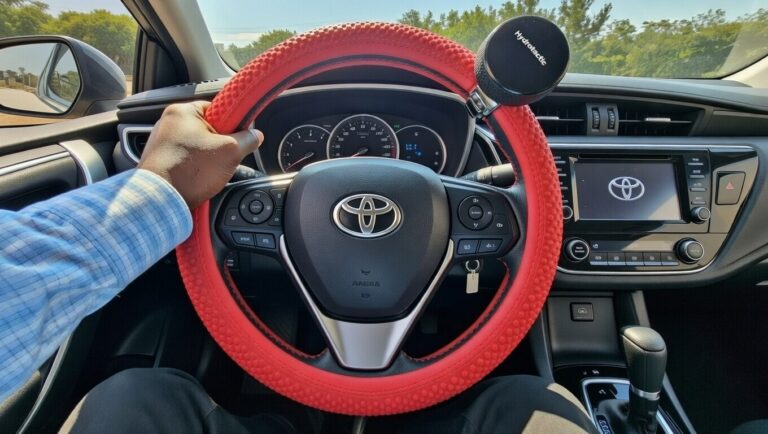
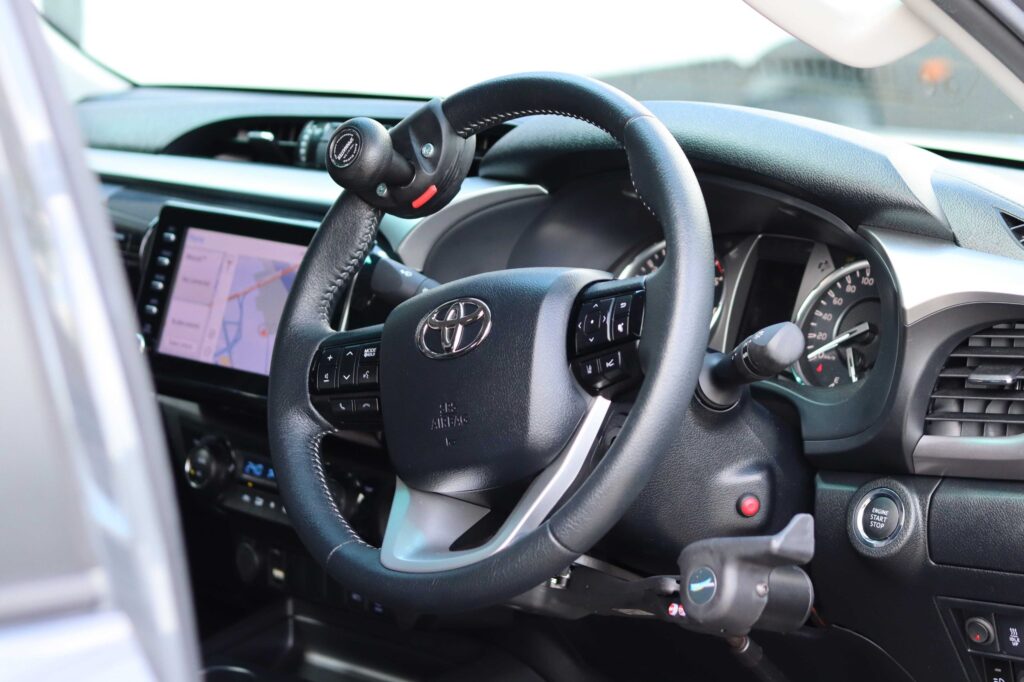
A steering wheel spinner knob is a small handle that clamps or bolts onto the outer rim of a steering wheel. It gives the driver a single, fixed grip point that rotates freely, allowing the wheel to be turned with one hand in a smooth, continuous motion.
The concept is straightforward. Instead of shuffling both hands around the wheel to complete a full turn, you grip the knob and guide the wheel through its full range of rotation. The knob spins on its own axis — usually via a ball bearing — so your hand stays in a comfortable, natural position throughout the movement.
Spinner knobs are typically small enough to fit in the palm of your hand. Most are between 40mm and 60mm in diameter and attach to the steering wheel using a clamp mechanism that tightens around the rim. No permanent modification to the vehicle is required. They can be fitted in seconds and removed just as quickly.
They are used on everything from cars and vans to trucks, forklifts, tractors, boats, and heavy plant machinery.
Despite their simplicity, they serve a genuinely important purpose — and for some drivers, they’re not optional. They’re essential.
How Does a Steering Wheel Spinner Knob Work?
The mechanics are deliberately simple.
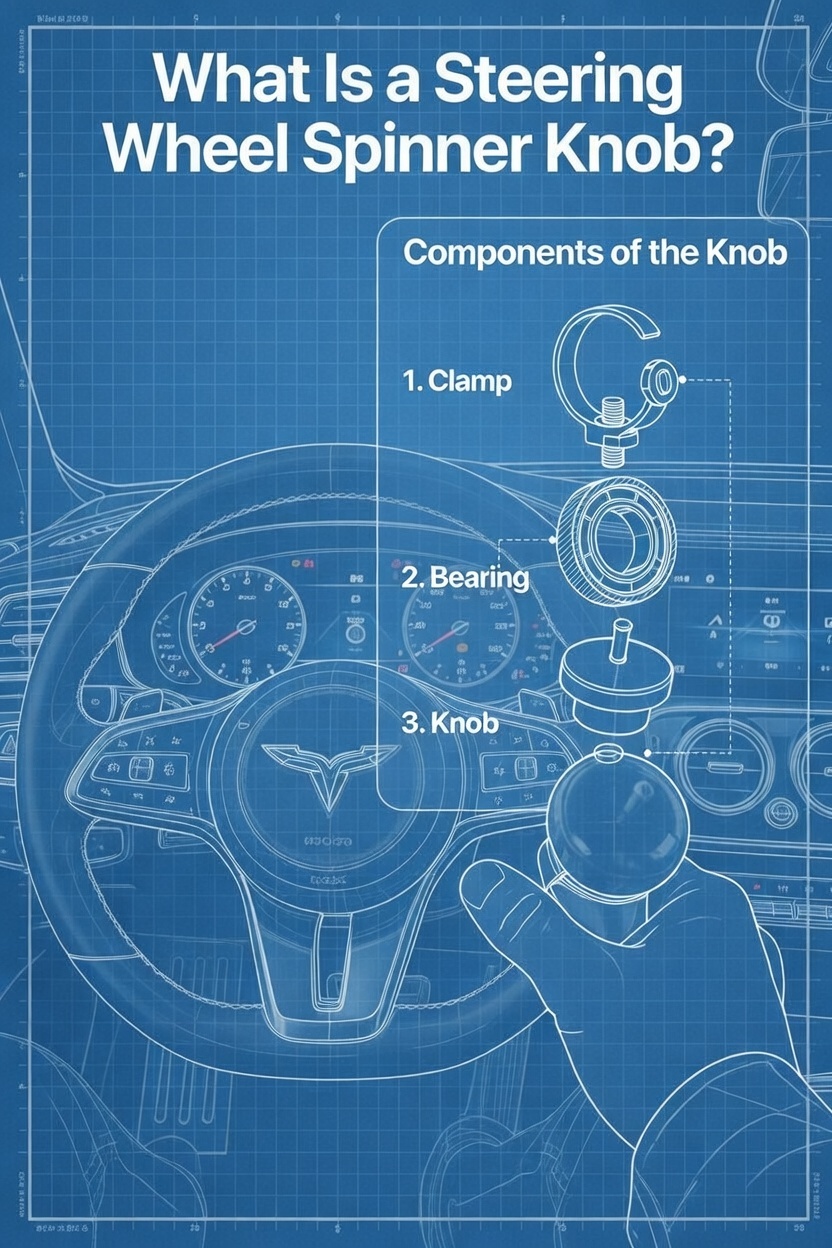
A steering wheel spinner knob consists of three core components:
1. The Clamp: This is the base that grips the steering wheel rim. Most use a screw-tightened clamp lined with rubber or silicone to hold firmly without scratching the wheel. Some heavy-duty versions use bolt-through fittings for permanent installation on commercial or agricultural vehicles.
2. The Bearing or Pivot Between the clamp and the knob itself sits a bearing — usually a sealed ball bearing. This allows the knob to rotate freely while the clamp stays fixed to the wheel. When you turn the steering wheel, your hand holds the knob stationary while it spins on its axis. This eliminates the need to release and re-grip the wheel during turns.
3. The Knob (Grip) The part you hold. This varies widely in shape — round, cylindrical, ergonomic, T-bar — depending on the intended use and the user’s physical needs.
In practice, using one looks like this:
You place your hand on the knob. To turn left, you push the knob through a clockwise arc. To turn right, counter-clockwise. Because the knob spins freely, your wrist doesn’t twist uncomfortably, and you never need to let go and re-grip the wheel mid-turn.
This is especially valuable when:
- Manoeuvring at low speeds (parking, reversing, tight turns)
- Operating vehicles with heavy or non-power-assisted steering
- Driving with the use of only one hand
A full 360-degree turn of the steering wheel can be completed in a single, fluid motion. Without a spinner knob, that same turn requires multiple hand-over-hand movements.
What Are the Different Names for Steering Wheel Spinner Knobs?
One product, many names. This causes confusion, so let’s clear it up.
Steering wheel spinner knob — The most common and descriptive modern term. This is what most people search for and what most manufacturers list.
Brodie knob — Named after Brody Manufacturing Company, which produced early versions for military and industrial vehicles. “Brodie knob” is still widely used, particularly in North America. [Source: Multiple historical automotive references trace the name to Brody Manufacturing]
Suicide knob — A colloquial term dating back to the mid-20th century. The name comes from the perceived danger of using one on vehicles without power steering — if the wheel kicked back (from hitting a pothole or kerb), the spinning knob could strike the driver’s wrist or arm with considerable force. Modern power steering has largely eliminated this risk, but the name persists. We cover the history of this term in more detail below.
Necker knob — American slang, mostly from the 1950s and 1960s. The idea was that a spinner knob let you steer with one hand, leaving the other arm free to put around your passenger. The name has faded from common use but still appears in vintage car communities.
Steering aid — A broader term used in occupational therapy, disability driving assessments, and by organisations like Motability. A steering wheel spinner knob is one type of steering aid. Others include steering balls, tri-pin grips, and amputee rings.
Power handle — A term sometimes used in Asia and in forklift/industrial contexts. Functionally identical.
All of these terms refer to the same fundamental device. The differences are regional, historical, or context-specific. Throughout this guide — and across this site — we use “steering wheel spinner knob” as the standard term for clarity.
Why Are They Called Suicide Knobs?
The name sounds alarming. The history explains why.
Before power steering became standard in passenger vehicles (widespread adoption didn’t happen until the 1950s-1970s, depending on the market), steering required significant physical effort. Manual steering systems transmitted road shocks directly through the steering column. If a front wheel hit a pothole, kerb, or rock, the steering wheel could violently kick back — spinning in the opposite direction with sudden force.
With a spinner knob fitted, this kickback could whip the knob into the driver’s hand, wrist, or forearm. In a worst-case scenario at speed, the force could cause the driver to lose control. This is where “suicide knob” originated — not because the knob itself was inherently deadly, but because on older vehicles without power steering, the consequences of kickback could be severe.
In modern vehicles with power steering, this risk is essentially eliminated. Power steering systems absorb road shocks before they reach the steering wheel. The violent kickback that gave suicide knobs their reputation simply doesn’t happen in any vehicle built in the last several decades.
The name survives as a cultural relic. It’s dramatic and memorable, which is exactly why it stuck. But it doesn’t reflect the reality of using a steering wheel spinner knob on any modern vehicle.
For a full breakdown of the safety question, including the specific concerns and what the evidence actually shows, see our guide: [Are Steering Wheel Spinner Knobs Safe? Myths vs Facts] (internal link — publish when article is live).
Who Uses Steering Wheel Spinner Knobs?
This is where the “novelty accessory” perception breaks down. Spinner knobs are used by a genuinely wide range of drivers, for genuinely practical reasons.
Disabled Drivers and Drivers with Reduced Mobility
This is the most important use case.
Drivers with one arm, limited grip strength, restricted shoulder or elbow movement, or conditions affecting upper limb function rely on spinner knobs as essential steering aids. For many, a spinner knob is what makes independent driving possible.
Conditions commonly associated with spinner knob use include:
- Upper limb amputation or limb difference
- Stroke recovery with hemiplegia (paralysis or weakness on one side)
- Arthritis affecting the hands, wrists, or shoulders
- Cerebral palsy
- Multiple sclerosis
- Muscular dystrophy
- Spinal cord injuries affecting upper limb function
- Recovery from shoulder, arm, or hand surgery
In the UK, steering aids, including spinner knobs, are regularly recommended by Driving Mobility assessment centres — a network of independent organisations that assess disabled drivers and recommend vehicle adaptations. [Source: Driving Mobility — About Us]
Spinner knobs can also be funded through the Motability Scheme as part of vehicle adaptations for disabled drivers receiving qualifying mobility allowances. [Source: Motability — Adaptations]
If a medical professional or DVLA requires you to use a steering aid as a condition of your licence, a spinner knob often fulfils that requirement.
Truck, HGV, and Commercial Vehicle Drivers
Long-haul truck drivers and delivery drivers who spend hours manoeuvring large vehicles in tight spaces — loading bays, depots, urban streets — use spinner knobs to reduce arm fatigue and make repeated low-speed turns easier.
On vehicles with large-diameter steering wheels and heavy steering (even with power assistance), a spinner knob significantly reduces the physical effort required.
Forklift Operators
Forklifts require constant, rapid steering adjustments in confined warehouse spaces. Spinner knobs are standard equipment on many forklifts from the factory. Operators repeatedly and quickly turn the wheel while simultaneously operating other controls. A spinner knob makes this possible with one hand, leaving the other free for hydraulic levers.
Many forklift manufacturers, including Toyota, Hyster, and Linde, fit spinner knobs as original equipment or list them as factory accessories.
Agricultural and Farm Vehicle Drivers
Tractors, combines, and other farm machinery often have large steering wheels and require frequent, wide turns at row ends in fields. Spinner knobs have been common on agricultural vehicles for decades.
Boat and Marine Operators
Steering wheels on boats — particularly sailboats and working vessels — are frequently fitted with spinner knobs for the same reason: they allow fast, one-handed steering while the other hand manages sails, throttles, or other equipment.
General Motorists
Some drivers simply prefer the feel and control of a spinner knob for everyday driving, particularly for parking and low-speed manoeuvring. There is nothing preventing any driver from fitting and using one in the UK, provided it doesn’t obstruct any controls or obscure any instruments.
For full details on legality, see our complete guide: Are Steering Wheel Spinner Knobs Legal in the UK?
Types of Steering Wheel Spinner Knobs
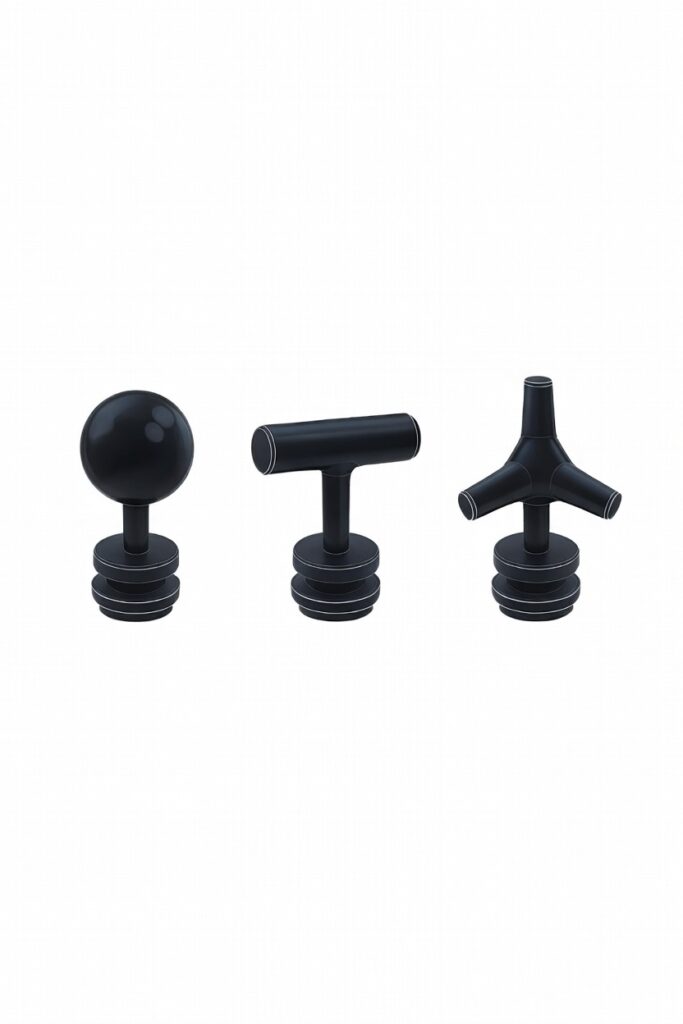
Not all spinner knobs are the same. The main variations are:
By Shape
Round / Ball: Spherical grip, fits in the palmGeneral use, most popular shape
Cylindrical / Barrel: Elongated grip, rolls slightly in the handUsers who prefer a broader grip surface
T-Bar / T-Handle: A horizontal bar extending from the clampUsers with limited grip — the wrist or forearm can hook over the bar.
Tri-Pin / Three-Pin: Three short pins arranged in a triangle patternPrescribed for drivers with very limited hand/finger function.
Ergonomic / Contoured: Shaped to follow the natural grip of the handComfort over long driving periods, reduced hand fatigue.
Flat / Paddle: A flat disc or paddle shapeSpecific disability requirements, sometimes prescribed
T-bar and tri-pin grips are more commonly recommended through formal disability driving assessments. Round and cylindrical knobs are the most common for general and commercial use.
By Attachment Method
Clamp-on — The most common type. A spring-loaded or screw-tightened clamp grips the steering wheel rim. Can be fitted and removed without tools. No modification to the wheel is required.
Bolt-on — A more permanent fixing, typically used on commercial, industrial, or agricultural vehicles. Requires drilling or a bracket system.
Suction / Adhesive — Rare and generally not recommended. These lack the grip strength of clamp or bolt systems and can detach under force. Avoid these for safety reasons.
By Bearing Type
Ball bearing — Smooth, free-spinning rotation. The standard on quality spinner knobs. Look for sealed bearings that resist dust and moisture.
Bushing / Sleeve — A simpler friction-based pivot. Cheaper to manufacture but doesn’t spin as freely. Common on very low-cost knobs.
No bearing — The cheapest knobs have no bearing at all — the knob is fixed or relies on loose tolerances to rotate. These create friction, can stick mid-turn, and defeat the entire purpose of a spinner knob. Avoid them.
The bearing is arguably the most important quality differentiator. A good sealed ball bearing is the difference between a spinner knob that works properly and one that’s frustrating to use.
What Are Steering Wheel Spinner Knobs Made From?
Common materials include:
Stainless Steel — Durable, heavy, premium feel. Won’t degrade in heat or cold. Often used on commercial and industrial knobs. Can feel cold in winter without gloves.
Aluminium — Lighter than steel, still durable. Often anodised or coated for grip and appearance.
ABS Plastic — Lightweight, affordable, comfortable, and temperature-resistant in all weather. The most common material for general-use knobs. Quality varies significantly between manufacturers.
Wood — Traditional, warm to the touch, aesthetically popular on classic cars and boats. Requires occasional maintenance (oil/varnish) to prevent cracking.
Silicone or Rubber-Coated — Soft-touch grip, comfortable for extended use, good for drivers with arthritis or grip sensitivity. Can wear over time.
Carbon Fibre — Lightweight and strong, primarily aesthetic. Found on aftermarket and performance-oriented knobs.
The best material depends on your use case. For a daily driver in the UK, ABS plastic or silicone-coated knobs offer the best balance of comfort, durability, and all-weather usability. For commercial vehicles and heavy equipment, stainless steel or aluminium is standard.
Are Steering Wheel Spinner Knobs Legal?
Yes — in the UK, steering wheel spinner knobs are legal. There is no law prohibiting their use on any vehicle driven on public roads.
They are not listed as a reason for MOT failure. They do not require notification to your insurance company in most cases, though there are nuances worth understanding.
We’ve written two detailed guides on this subject:
- Steering Wheel Spinner Knobs: UK Law, MOT & Insurance — The Complete Guide
- Are Steering Wheel Spinner Knobs Legal in the UK?
These cover the specific legislation, what MOT testers look for, and when (if ever) you might need to inform your insurer.
A Brief History of the Steering Wheel Spinner Knob
Spinner knobs are not a modern invention.
1930s–1940s: Early spinner knobs appeared on military vehicles, agricultural equipment, and industrial machinery where rapid, one-handed steering was a practical necessity. The Brody Manufacturing Company is frequently credited with popularising them — hence the name “Brodie knob.” [Source: Wikipedia — Brodie Knob]
1950s–1960s: Spinner knobs became fashionable on American passenger cars. Hot rod culture embraced them. This is the era that produced the “necker knob” nickname. However, this is also when safety concerns emerged — vehicles of this period overwhelmingly used manual steering, and steering wheel kickback was a genuine risk.
1970s–1990s: As power steering became standard, the kickback safety argument faded. Spinner knobs remained common on trucks, forklifts, tractors, and boats. Some US states introduced restrictions during this period, many of which remain on the books today — though enforcement and practical relevance vary widely.
2000s–Present: Growing recognition of spinner knobs as disability aids and professional driving tools. Occupational therapy and disability driving organisations formally recommend them. They are standard equipment on most forklifts and widely used in commercial fleets worldwide.
The steering wheel spinner knob has moved from military tool to hot rod accessory to medical aid to everyday driving convenience over the course of 80+ years. That versatility is precisely why they’ve endured.
Frequently Asked Questions
Is a steering wheel spinner knob the same as a brodie knob?
Yes. “Brodie knob” is an older name for the same device, originating from the Brody Manufacturing Company. The terms are interchangeable.
Can I fit a spinner knob to any steering wheel?
Most clamp-on spinner knobs are designed to fit steering wheels with a rim diameter between approximately 25mm and 42mm, which covers the vast majority of passenger cars, vans, and trucks. Always check the clamp range against your specific steering wheel before purchasing.
Do spinner knobs damage the steering wheel?
Quality clamp-on spinner knobs use rubber or silicone-lined clamps to prevent marking. On leather or soft-material steering wheels, it’s worth checking periodically for any compression marks, but permanent damage is uncommon with a properly fitted knob.
Do I need a spinner knob with a bearing?
For proper function, yes. A bearing (ideally a sealed ball bearing) allows the knob to spin freely, which is the entire point. A knob without a bearing will create friction, resist turning, and may cause your hand to slip during manoeuvres. A bearing-equipped knob is always worth the modest extra cost.
Can I use a steering wheel spinner knob on my driving test?
If a spinner knob has been recommended as part of a driving assessment or medical requirement, yes — you should use it during your test, and the test will be conducted in a vehicle fitted with it. If you simply prefer to use one and have no formal requirement, check with your driving instructor and test centre in advance.
Where should I position a spinner knob on the steering wheel?
The most common recommendation is to place the 9 o’clock and 10 o’clock positions for right-handed drivers, and the 2 o’clock and 3 o’clock positions for left-handed drivers. However, drivers using a spinner knob as a prescribed disability aid should follow the positioning recommended by their occupational therapist or driving assessor, as optimal placement depends on individual physical needs.
Summary
A steering wheel spinner knob is a simple, effective device that allows a driver to turn the steering wheel with one hand in a smooth, continuous motion. Known also as a brodie knob, suicide knob, or necker knob, it has been in continuous use for over 80 years across military, industrial, agricultural, commercial, and passenger vehicles.
Today, it serves two primary audiences: drivers with disabilities or reduced mobility who depend on it as an essential steering aid, and professional/commercial drivers who use it to reduce fatigue and improve control during frequent manoeuvring.
It is legal in the UK, it does not cause an MOT failure, and in most cases, it does not need to be declared to your insurer. For full details on the legal position, see our complete UK law, MOT and insurance guide.