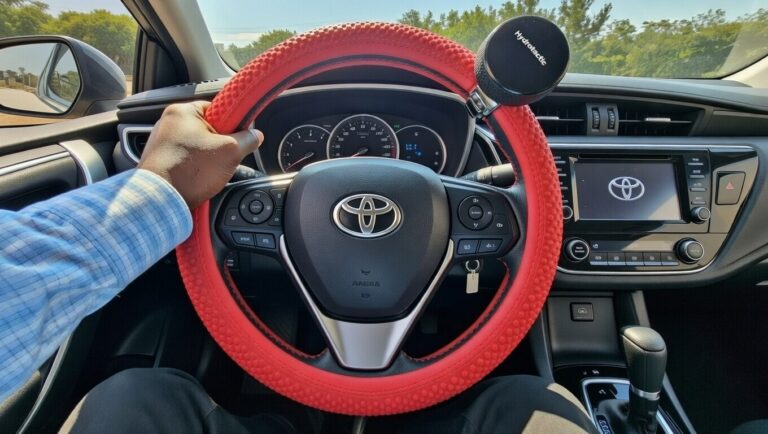
You’ve found a steering wheel spinner knob. Maybe you’ve already bought one. Maybe you’ve been using one for years on a forklift or tractor, and now you’re wondering whether you can fit one to your car.
Then the doubts creep in.
Will it fail my MOT? Is it even legal? What happens if I have an accident and my insurer spots it?
These are fair questions. And if you’ve tried searching for clear answers, you’ve probably noticed something: nobody gives you one. You get forum threads from 2011. You get vague Reddit replies. You get affiliate blog posts that dance around the subject without citing a single piece of legislation.
This guide is different.
We’ve gone through the law, the MOT inspection manual, and the obligations you have to your insurer. Every claim in this article is referenced, and every source is linked so you can verify it yourself.
Whether you’re a disabled driver who’s been prescribed a steering aid, a tradesperson who wants more control in a van, or someone who simply finds spinner knobs more comfortable, here’s everything you need to know.
What Exactly Is a Steering Wheel Spinner Knob?
Before we get into the legal side, let’s be precise about what we’re talking about.
A steering wheel spinner knob — also called a brodie knob, suicide knob, or simply a steering aid — is a handle that clamps or bolts onto a vehicle’s steering wheel rim. It gives the driver a single grip point, allowing the wheel to be turned with one hand using a spinning motion rather than the traditional hand-over-hand technique.
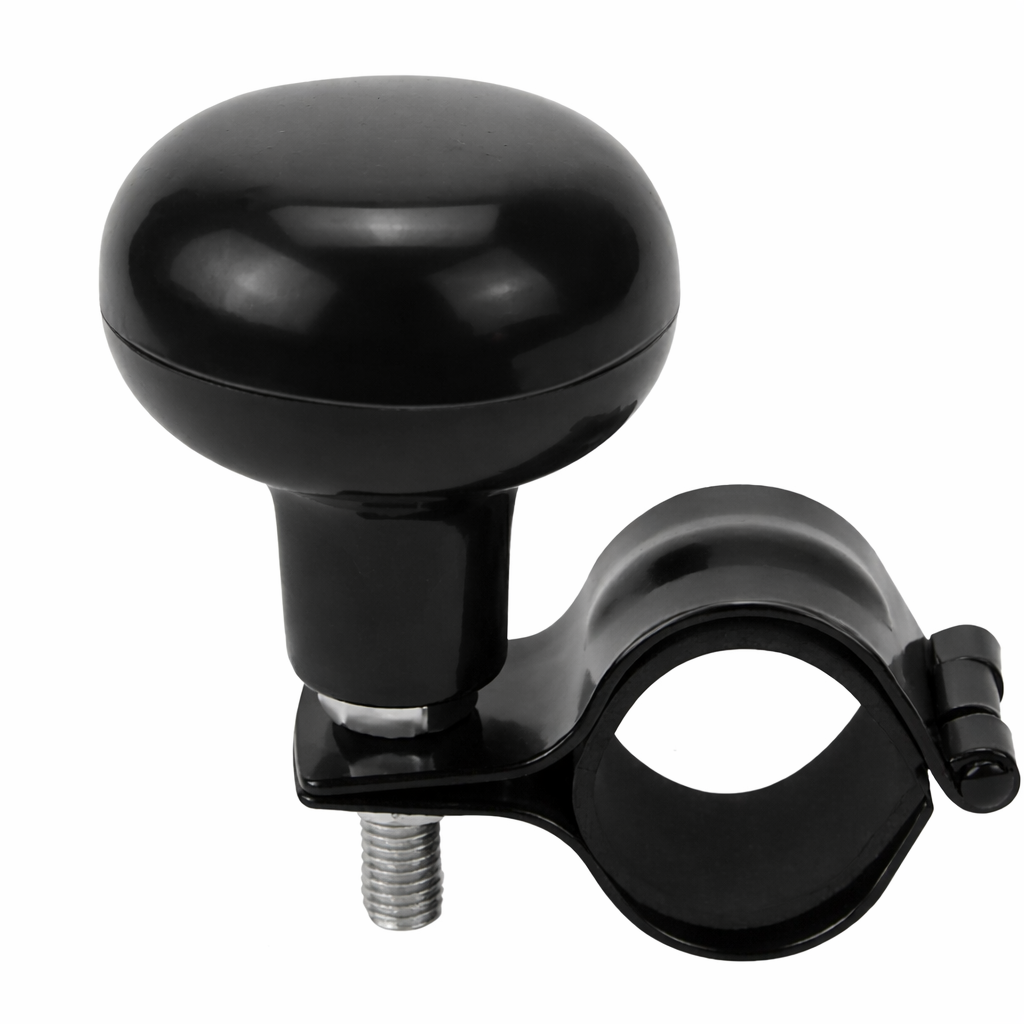
Despite online debate, spinner knobs are widely used in legitimate contexts.
They are commonly fitted to:
- Forklifts and warehouse vehicles (almost universally fitted)
- Tractors and agricultural machinery
- HGVs, lorries, and coaches
- Adapted vehicles for disabled drivers
- Cars and vans (aftermarket fitment)
In fact, steering aids are routinely recommended through driving assessment centres for drivers with certain mobility limitations.
They are tools — not gimmicks.
The names vary by region and era. In the US, “suicide knob” stuck from slang: pre-power-steering days when a kicked-back wheel could spin the knob into your wrist. Modern power steering has largely eliminated that risk, but the nickname endured.
In the UK mobility and occupational therapy world, they’re formally referred to as steering aids or steering devices and are regularly prescribed by driving assessment centres.
TL;dr: A steering wheel spinner knob is not a novelty item. It’s a functional driving tool with a century-long track record across commercial, agricultural, and adapted vehicle use.
Are Steering Wheel Spinner Knobs Legal in the UK?
Short answer: yes. There is no UK law that prohibits the fitting or use of a steering wheel spinner knob on a road vehicle.
Now the longer answer — because the short one, on its own, isn’t good enough.
The Legislation That Actually Applies
The primary piece of law governing how vehicles are built, modified, and maintained on UK roads is the Road Vehicles (Construction and Use) Regulations 1986. This is a statutory instrument made under the Road Traffic Act 1988, and it covers everything from tyre tread depth to mirror placement to — relevantly — steering gear.
Road Vehicles (Construction and Use) Regulations 1986 — Full Text (legislation.gov.uk)
Two regulations within this instrument are directly relevant:
Regulation 104 — Steering Gear
This states:
“All steering gear fitted to a motor vehicle shall at all times while the vehicle is used on a road be maintained in good and efficient working order and be properly adjusted.”
Regulation 104 — legislation.gov.uk
A spinner knob that is properly fitted, secure, and does not interfere with the free and full operation of the steering mechanism satisfies this regulation. A spinner knob that is loose, cracked, or positioned in a way that jams the wheel’s rotation would not.
Regulation 100 – Maintenance and Use of Vehicle So As Not to Be a Danger
This is the broader catch-all:
“A motor vehicle, every trailer drawn thereby and all parts and accessories of such vehicle and trailer shall at all times be in such condition… that no danger is caused or is likely to be caused to any person on the vehicle or on a road.”
Regulation 100 — legislation.gov.uk
Again, this doesn’t ban spinner knobs. It bans anything that creates danger. A properly fitted spinner knob on a power-steering vehicle does not create a dangerous condition. An ill-fitted one, on any vehicle, could.
What the Highway Code Says
The Highway Code does not mention steering wheel spinner knobs, brodie knobs, or aftermarket steering aids. It simply requires that you maintain full control of your vehicle at all times (Rules 97 and 160).
A spinner knob, properly used, does not compromise vehicle control. For many drivers — particularly those with limited grip strength or single-arm use — it significantly improves control.
So, Why Do People Think Steering Wheel Knobs are Illegal?
Three reasons, all of them based on confusion:
- American state laws. Several US states restricted or banned spinner knobs decades ago. These laws get repeated in forums without anyone noting they don’t apply in the UK.
- The “suicide knob” name. The word “suicide” makes people assume there’s a safety ban. There isn’t. The name comes from a pre-power-steering era risk that barely applies to modern vehicles.
- Lack of explicit permission. UK law doesn’t tend to list everything that’s allowed. It lists what’s prohibited or regulated. Spinner knobs are neither prohibited nor specifically regulated — which means they’re legal.
The bottom line: Fitting a steering wheel spinner knob to your vehicle is legal in the UK, provided it is securely fitted and does not impair the safe operation of the steering system. The relevant law is the Road Vehicles (Construction and Use) Regulations 1986, specifically Regulations 100 and 104.
Will a Steering Wheel Spinner Knob Fail My MOT?
Short answer: A spinner knob is not an MOT test item, and a properly fitted one should not cause a failure.
Let’s walk through why.
What the MOT Test Actually Checks on Steering
The MOT inspection manual for cars and light commercial vehicles is published by the Driver and Vehicle Standards Agency (DVSA) and is freely available online. Section 2 covers the steering system.
MOT Inspection Manual — Section 2: Steering (gov.uk)
The tester inspects:
- Steering wheel condition (cracks, deformation, security to the column)
- Steering column (play, wear, corrosion, universal joints)
- Steering mechanism and rack (leaks, damage, security)
- Power steering operation and fluid
- Steering linkages (track rod ends, ball joints, drag links)
- Steering wheel play (free movement before the road wheels respond)
At no point does the manual, instruct testers to check for, or fail a vehicle because of an aftermarket steering aid, spinner knobs, or similar accessories.
When Could It Become a Problem?
In theory, an MOT tester could raise an issue if:
- The knob physically interferes with steering wheel rotation — for example, if it is excessively large, incorrectly positioned, or installed in a way that causes it to catch on interior components, controls, or the driver’s clothing.
- The knob is loose, cracked, or damaged — an insecure or defective spinner knob may be regarded as an accessory in a dangerous condition under general vehicle maintenance requirements.
- It obscures the horn or airbag module — if the knob is fitted to the centre of the wheel (which would be unusual), this could create a problem. Standard spinner knobs clamp to the outer rim and don’t affect horn or airbag access.
In practice, MOT testers see spinner knobs regularly. They’re standard equipment on many commercial vehicles, and testers in areas with large farming communities will see them on almost every tractor that comes through.
What to Do if a Tester Questions It
If an MOT tester is uncertain about your spinner knob, they may refer to the DVSA’s general guidance on aftermarket modifications. You’re within your rights to:
- Ask them to identify the specific Reason for Rejection (RfR) from the MOT manual
- Point out that spinner knobs are not listed in the manual’s failure criteria
- Note that the item is in secure condition and does not impair steering function
If the knob is genuinely secure and correctly fitted, there is no basis for an MOT failure. If you believe a failure has been issued incorrectly, you can appeal an MOT result through the DVSA.
The bottom line: The MOT test manual does not list spinner knobs as an inspection item. A securely fitted spinner knob that doesn’t obstruct steering movement will not cause an MOT failure.
Do You Need to Tell Your Insurance Company?
Short answer: yes, you should disclose it. No, it almost certainly won’t increase your premium. But failing to mention it could give your insurer grounds to dispute a claim.
This is the section most people skip — and it’s the one that actually matters most.
The Legal Framework: Consumer Insurance Act 2012
Since January 2013, the Consumer Insurance (Disclosure and Representations) Act 2012 has governed the relationship between individual policyholders and insurers in the UK. It replaced the older (and much harsher) duty of “utmost good faith” with something more practical.
Consumer Insurance (Disclosure and Representations) Act 2012 — legislation.gov.uk
Under this Act, you don’t have a blanket duty to volunteer every piece of information. Instead, you have a duty to take reasonable care not to make a misrepresentation when answering your insurer’s questions.
Here’s where it gets relevant.
Almost every UK motor insurance application or renewal asks some version of this question:
“Has the vehicle been modified from the manufacturer’s standard specification?”
A steering wheel spinner knob is a modification. It’s a component fitted to the vehicle that wasn’t there when it left the factory. It doesn’t matter how small it is, how common it is, or how little it affects performance. If your insurer asks about modifications and you don’t mention it, you’ve made a misrepresentation.
What Happens if You Don’t Disclose?
Under the 2012 Act, the consequences depend on whether your non-disclosure was:
- Deliberate or reckless — the insurer can void your policy entirely and refuse all claims
- Careless — the insurer can adjust your claim to reflect what they would have done had they known (which might mean paying out at a reduced rate, or applying different terms)
In reality, the risk isn’t that your insurer charges you more for a spinner knob. The risk is that after an accident — when thousands of pounds are on the line — an insurer’s claims assessor spots an undeclared modification and uses it as leverage to reduce or reject your claim.
A spinner knob is unlikely to be the sole reason a claim is rejected. But if it’s part of a pattern of undisclosed changes, or if the accident involves steering in any way, it becomes ammunition.
How to Disclose It (And What to Expect)
Most people find the process straightforward:
- Call your insurer (or use their online modification declaration form)
- Describe the modification: “I’ve fitted a steering wheel spinner knob/steering aid to the steering wheel rim”
- Wait for confirmation. Most insurers will note it on your policy with no change to your premium
If the spinner knob has been prescribed as a disability steering aid through a driving assessment centre, mention this specifically. Insurers are accustomed to prescribed vehicle adaptations through the Motability scheme and similar programmes, and these are typically accepted without question.
Some insurers may add it to your policy notes as a “non-standard accessory.” A few specialist modification insurers may ask whether it’s a clamp-on or permanently bolted type. None of this should affect your premium for such a minor fitting.
What About Motability Vehicles?
If your vehicle is provided through the Motability Scheme, any prescribed adaptations — including steering aids — are arranged through the scheme itself and are already covered under the insurance package included with your lease. You do not need to separately declare prescribed modifications on a Motability vehicle.
Motability — Vehicle Adaptations
The bottom line: Declare your spinner knob to your insurer. It takes five minutes, it almost never affects your premium, and it removes any risk of a disputed claim down the line. The legal basis is the Consumer Insurance (Disclosure and Representations) Act 2012.
Steering Wheel Spinner Knobs as Disability Aids
This section deserves its own space because the context is fundamentally different. For many disabled drivers, a steering wheel spinner knob isn’t an accessory — it’s the thing that makes driving possible.
Who Uses Them?
Spinner knobs and similar steering aids are commonly prescribed for drivers with:
- Upper limb amputation or limb difference (single-arm drivers)
- Arthritis, particularly in the hands, wrists, or shoulders
- Stroke recovery, where one side of the body has reduced strength or coordination
- Cerebral palsy or other conditions affecting grip and fine motor control
- Spinal cord injuries affecting upper body movement
- Repetitive strain injuries or chronic pain conditions
How They’re Prescribed
In the UK, if a medical condition affects your ability to drive, you may be referred to (or can self-refer to) a driving assessment centre that’s part of the national network coordinated by the Forum of Mobility Centres.
Forum of Mobility Centres — Find an Assessment Centre
At the assessment, a qualified driving assessor (often an occupational therapist with specialist training) will evaluate your physical capabilities and recommend appropriate vehicle adaptations. A steering wheel spinner knob is one of the most frequently recommended aids.
The assessment centre’s report can then be used to:
- Inform the DVLA of your recommended adaptations (which may be noted on your licence as a driving licence restriction code)
- Arrange fitting through approved adaptation installers
- Support a Motability application if you’re applying for a scheme vehicle
DVLA Licence Codes
If a steering aid is formally prescribed, the DVLA may add a code to your driving licence. The relevant code is typically:
- Code 42 — “Modified steering” (sometimes applied when a prescribed steering aid is a condition of your licence)
You can check the full list of DVLA restriction codes here: DVLA Information Codes — gov.uk
Not all spinner knob users will have a licence code. If you’ve fitted one voluntarily (without a medical prescription), no licence code applies. If it’s been formally prescribed as part of a driving assessment, it may or may not result in a code depending on the DVLA’s medical team’s decision.
VAT Relief on Disability Aids
If you are a disabled person and the spinner knob is for personal use to aid your driving, you may be entitled to purchase it VAT-free under HMRC’s VAT relief for disabled people scheme. This applies to goods designed or adapted for disabled use.
VAT Relief on Goods for Disabled People — gov.uk
The relief is applied at the point of purchase. You’ll typically need to sign a declaration confirming you have a qualifying condition. No proof or medical certificate is required at the time of purchase — it works on an honour basis backed by legal declaration.
Key point for disabled drivers: A spinner knob prescribed through a driving assessment centre is a recognised, legitimate vehicle adaptation. It has a clear pathway through the DVLA, Motability, and insurance systems. There is nothing unofficial, grey-area, or risky about using one.
Safety: Addressing the Concerns Honestly
We’re not going to pretend concerns don’t exist. If you’ve read about spinner knobs online, you’ve seen people call them dangerous. Let’s address the actual risks with actual context.
The Historical Risk (Pre-Power Steering)
Before power steering became standard, a front wheel hitting a kerb or pothole could cause violent kickback through the steering column. If your hand was wrapped around a spinner knob when this happened, the sudden spin could injure your wrist, thumb, or forearm.
This was a genuine risk. It’s the origin of the “suicide knob” name, and it’s why some US states introduced restrictions in the 1950s and 1960s.
However. Power steering — which is fitted to virtually every car, van, and truck manufactured in the last 30 years — absorbs these forces. Kickback through a power-assisted steering column is negligible. The mechanism that made spinner knobs dangerous simply doesn’t exist in modern vehicles.
The Airbag Concern
Some people worry that a spinner knob could interfere with the steering wheel airbag. Here’s the reality:
- Standard spinner knobs clamp to the outer rim of the steering wheel
- The airbag module is housed in the centre boss of the wheel
- There is typically 10-15cm of clearance between a rim-mounted knob and the airbag cover
- When an airbag deploys, it expands outward from the centre toward the driver. A rim-mounted knob is not in the deployment path
Could an extremely large, poorly positioned, or centre-mounted knob theoretically interfere with an airbag? In a contrived scenario, perhaps. But a standard rim-mounted spinner knob of normal dimensions does not affect airbag deployment.
The Genuine Safety Consideration
The one legitimate modern safety concern is fitment quality. A spinner knob that:
- Is not securely clamped
- Uses a clamp too small for the wheel’s rim diameter
- Is made of brittle material that could crack under load
- Has a seized bearing (on rotating models) that makes release difficult
…could potentially create a problem. This is an argument for buying from a reputable source and checking the clamp periodically — not an argument against using a spinner knob.
Honest summary: On a modern, power-steering-equipped vehicle, a properly fitted spinner knob of appropriate size and quality does not present a meaningful safety risk. The historical dangers that earned these devices their reputation are mechanical artefacts of a pre-power-steering era.
Frequently Asked Questions
Can I use a steering wheel spinner knob on my driving test? Yes, if it has been recommended as part of a formal driving assessment and your driving instructor is aware. Many disabled learner drivers use spinner knobs from their very first lesson. Inform your test centre in advance so the examiner is prepared.
Do I need a prescription to buy a steering wheel spinner knob? No. Anyone can purchase and fit one. A prescription or driving assessment recommendation is only relevant if you’re going through the Motability scheme, need a DVLA licence code, or want to claim VAT relief.
Are spinner knobs legal on motorways? Yes. There is no road type restriction. If it’s legal on an A-road, it’s legal on a motorway. The same Construction and Use Regulations apply everywhere.
Can I fit a spinner knob to a leather steering wheel? Yes, though you should use a knob with a padded or rubber-lined clamp to avoid marking or compressing the leather. Some drivers place a small protective wrap under the clamp.
Will fitting a spinner knob void my car warranty? Highly unlikely, as it’s a non-invasive, clamp-on accessory that doesn’t alter any vehicle system. However, if you’re concerned, check your warranty terms or ask your dealer. A manufacturer would struggle to argue that a clamp-on steering aid caused a mechanical failure elsewhere in the vehicle.
What about spinner knobs on company or fleet vehicles? Check your fleet policy. Many fleet operators permit or even supply steering aids, particularly for drivers with declared medical conditions. Your fleet manager or occupational health department can advise on the company’s modification policy.
Summary: What You Actually Need to Know
QuestionAnswerAre spinner knobs legal in the UK?Yes. No law prohibits them. The Road Vehicles (Construction and Use) Regulations 1986 require that all steering components are maintained in safe, working condition — which a properly fitted knob satisfies.Will one fail my MOT?Not if it's securely fitted and doesn't obstruct steering. The MOT inspection manual does not list spinner knobs as a test or failure item.Do I need to tell my insurer?Yes. It's a modification. Disclosure takes minutes and almost never affects your premium. Non-disclosure could complicate a future claim.Are they safe on modern cars?Yes. The historical risks related to pre-power-steering kickback. On modern vehicles with power steering, properly fitted spinner knobs present no meaningful safety concern.Can disabled drivers use them?Absolutely. They are one of the most commonly prescribed steering aids in the UK, supported through driving assessment centres, the Motability scheme, and DVLA licence coding.
Sources & Official References
All claims in this article are supported by the following publicly available sources:
- Road Vehicles (Construction and Use) Regulations 1986 — UK legislation governing vehicle standards
- Regulation 100 — Maintenance and condition — General safety obligation
- Regulation 104 — Steering gear — Steering system maintenance requirement
- MOT Inspection Manual — Section 2: Steering — DVSA official test procedures
- Consumer Insurance (Disclosure and Representations) Act 2012 — Insurance disclosure obligations
- The Highway Code — Road user rules
- DVLA Driving Licence Codes — Restriction and information codes
- Forum of Mobility Centres — UK driving assessment centre network
- Motability Scheme — Adaptations — Scheme vehicle modifications
- VAT Relief for Disabled People — HMRC relief on aids and equipment
- Appeal an MOT Result — DVSA disputes process
This guide was last reviewed and updated in 2025. Laws and MOT test standards are subject to change. If you’re in any doubt about a specific modification to your vehicle, contact the DVSA or your insurer directly.