Do You Need to Declare a Steering Wheel Spinner Knob to Your Car Insurance?
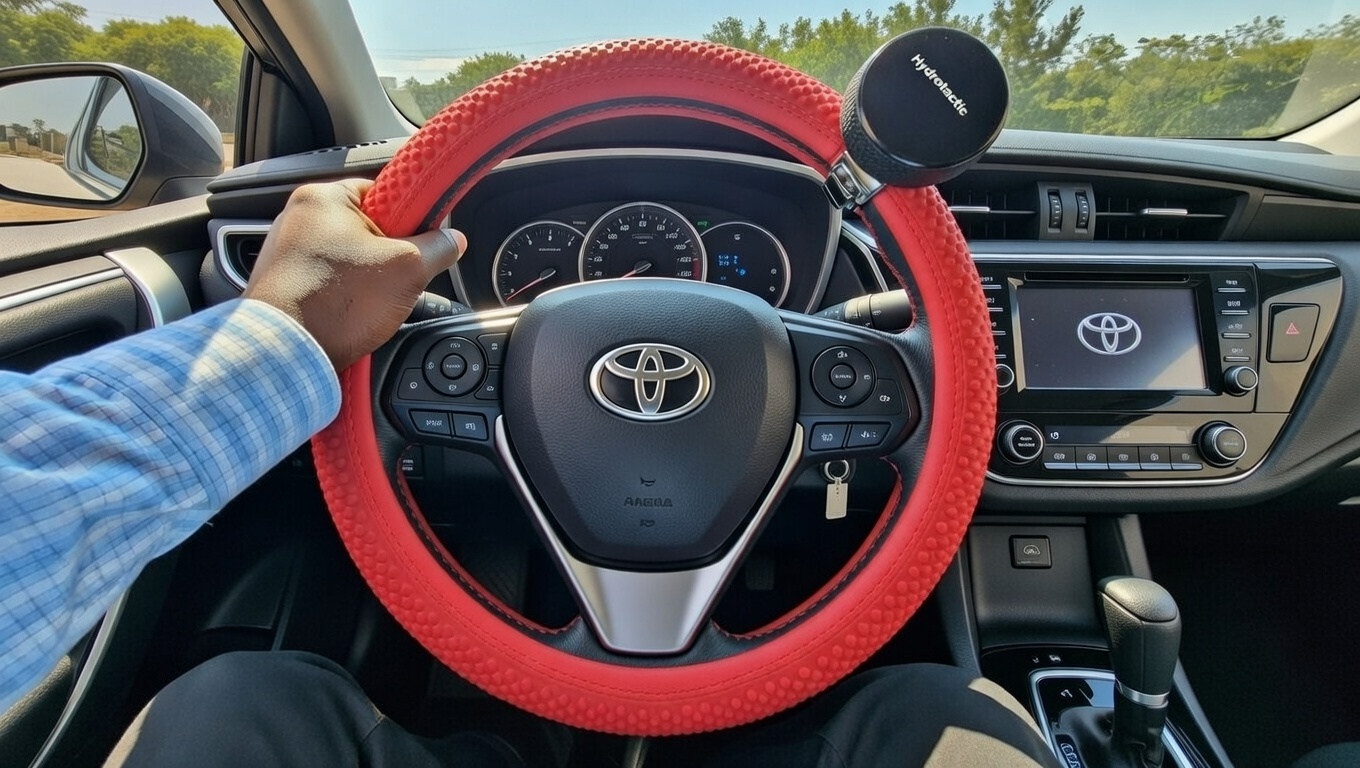
Of all the questions people ask before fitting a steering wheel spinner knob, this one carries the most financial anxiety.
Not because a spinner knob is expensive. But because the consequences of getting insurance wrong in the UK can be severe — a voided policy, a rejected claim, or even an accusation of fraud. Nobody wants that over a £15 steering accessory.
So let’s answer this properly, with reference to the actual law, how insurers operate in practice, and what you should do.
The short answer: UK insurance law does not require you to proactively declare every minor accessory fitted to your vehicle. However, most motor insurance policies include terms requiring you to notify the insurer of modifications. A steering wheel spinner knob is unlikely to affect your premium or cover, but notifying your insurer takes five minutes and removes all risk. We recommend you do it.
The rest of this guide explains why, what the law actually says, what happens if you don’t, and how to handle the conversation.
The Law: What You’re Actually Required to Disclose
UK insurance disclosure obligations are governed by two key pieces of legislation, depending on whether you hold a personal or commercial policy.
Personal Motor Insurance: The Consumer Insurance (Disclosure and Representations) Act 2012
Before this Act came into force on 6 April 2013, consumers had a broad legal duty to volunteer any information that might be relevant to an insurer. This was the old doctrine of “utmost good faith” (uberrimae fidei), and it placed an enormous burden on the policyholder to guess what the insurer might want to know.
The 2012 Act changed that. Under current law:
- You do not have a general duty to volunteer information. The insurer must ask you specific questions, and you must answer them honestly and with reasonable care.
- Your duty is to take “reasonable care not to make a misrepresentation.” This means you must not give false or misleading answers to the questions your insurer asks.
- If the insurer doesn’t ask about something, you generally cannot be penalised for not mentioning it. The burden has shifted to the insurer to ask the right questions.
What this means for a spinner knob: If your insurer’s application or renewal form asks “Have you made any modifications to the vehicle?” and you answer “No” after fitting a spinner knob, you are potentially making a misrepresentation — even if the modification is minor. If the form doesn’t ask about modifications at all, you have no legal obligation to volunteer the information.
Source: Consumer Insurance (Disclosure and Representations) Act 2012. (legislation.gov.uk)
Commercial Motor Insurance: The Insurance Act 2015
If your vehicle is insured under a commercial fleet policy or a business-use policy, the Insurance Act 2015 applies instead. This Act imposes a duty of fair presentation — a slightly higher standard than the Consumer Act.
Under this duty, a business policyholder must:
- Disclose every material circumstance they know or ought to know
- Present information in a reasonably clear and accessible way
A material circumstance is anything that would influence the judgment of a prudent insurer in deciding whether to accept the risk, and on what terms.
For commercial policies, It is more important to disclose even minor modifications, including a spinner knob, because the threshold for “material circumstance” is broader. Fleet managers and business vehicle operators should notify their insurer or broker.
Source: Insurance Act 2015. (legislation.gov.uk)
What Counts as a “Modification” in Insurance Terms?
This is where the practical confusion sits. The word “modification” evokes images of engine swaps, body kits, and lowered suspension. A small knob clamped to your steering wheel doesn’t feel like it belongs in the same category.
And in most insurers’ internal risk models, it doesn’t. But the policy wording usually doesn’t make that distinction.
How Most UK Motor Insurers Define “Modification”
The Association of British Insurers (ABI) does not publish a single binding definition. Each insurer uses its own policy wording. However, the most common definitions fall into one of these patterns:
Broad definition (most common):
“Any change to the vehicle from the manufacturer’s standard specification, including additions, removals, or alterations to any component, accessory, or feature.”
Under this wording, a steering wheel spinner knob technically qualifies. So does a phone mount, a roof rack, a dashcam hardwired to the fusebox, or an aftermarket gear knob.
Narrow definition (less common):
“Any change that affects the performance, value, or appearance of the vehicle.”
Under this wording, a spinner knob is much harder to classify as a modification. It doesn’t affect performance (the steering ratio, power, or braking are unchanged). It has a negligible effect on the vehicle’s value. Its effect on appearance is minimal and reversible.
The practical reality: Most insurers use the broad definition in their policy documents but apply common sense in practice. When you call to declare a spinner knob, the agent will typically note it and confirm that there will be no change to the terms. This is a routine interaction that takes minutes.
What Happens If You Don’t Declare It?
This is the question that generates the most anxiety, so let’s be precise about the actual consequences under UK law.
Scenario 1: You Don’t Declare It and Never Make a Claim
Nothing happens. Your policy continues. You pay your premiums. Nobody investigates your steering wheel.
Insurers do not conduct pre-claim vehicle inspections to check for undeclared accessories. Unless a claim triggers an investigation, the presence of a spinner knob is never examined.
This does not mean it’s fine to not declare it. It means the risk is dormant until you need your insurance most, at the point of a claim.
Scenario 2: You Don’t Declare It and Make a Claim
This is where non-disclosure becomes a real problem, and the severity depends on the type of misrepresentation:
Under the Consumer Insurance Act 2012, misrepresentations are classified as:
TypeDefinitionInsurer's RemedyDeliberate or recklessYou knew the information was wrong or didn't care whether it wasInsurer can void the policy entirely — treat it as if it never existed. They can refuse the claim, keep your premiums, and you have no cover.CarelessYou didn't take reasonable care when answeringInsurer can adjust the claim based on what they would have done had they known the truth. If they would still have insured you (likely, for a spinner knob), they pay the claim — potentially with adjusted terms. If they would have charged a higher premium, they can proportionally reduce the payout.InnocentYou took reasonable care but still got it wrongInsurer must pay the claim in full. No penalty.
The critical question: Would an insurer classify a non-disclosed spinner knob as deliberate, careless, or innocent misrepresentation?
In practice, for a small, removable, non-performance accessory like a spinner knob:
- It is very unlikely to be classified as deliberate or reckless unless you were specifically asked about steering modifications and said no
- It would most likely be classified as careless at worst, meaning the insurer adjusts rather than voids
- An argument for innocent non-disclosure is strong, particularly if the insurer’s questions were vague or didn’t specifically mention accessories
However, This analysis only applies after the fact, during a stressful claim process. The far simpler approach is to declare it and remove the question entirely.
Scenario 3: You Don’t Declare It and Have a Serious Accident
In a serious or high-value claim — particularly one involving injury to a third party — insurers investigate more thoroughly. Adjusters may inspect the vehicle, photograph the interior, and note any non-standard features.
If a non-disclosed modification is found during investigation, the insurer has grounds to scrutinise the policy more broadly. Even if the spinner knob itself is irrelevant to the accident, it creates an opportunity for the insurer to argue that the policyholder’s disclosure was careless, which opens the door to other questions about the accuracy of the application.
This is the real risk. Not that the spinner knob itself voids your insurance. But that non-disclosure of anything — however minor — gives an insurer a lever during a claim dispute.
Our strong recommendation: Declare it. Remove the lever entirely.
Will Your Premium Increase?
Almost certainly not.
Insurers price risk based on factors that affect the likelihood and severity of claims:
- Driver age and experience
- Vehicle make, model, and engine size
- Postcode and annual mileage
- Claims history and driving convictions
- Significant modifications that affect performance or theft risk
A steering wheel spinner knob does not affect:
- Engine performance
- Top speed or acceleration
- Braking distance
- Theft attractiveness
- Repair costs after an accident
When you declare a spinner knob, the most common insurer response is to note it on the policy with no change to the premium or terms. Some insurers may not even have a category for it and will simply add a free-text note.
If an insurer attempted to increase your premium solely because of a spinner knob, you would have strong grounds to question the basis for that increase — and to shop around, because the vast majority of competitors will not price it as a risk factor.
How to Tell Your Insurer: A Practical Script
Declaring a spinner knob is straightforward. Here’s how the conversation typically goes:
By Phone
Call your insurer’s modifications or changes line. Say:
“I’d like to notify you of a minor accessory I’ve fitted to my vehicle. I’ve attached a steering wheel spinner knob — it’s a small knob that clamps onto the steering wheel rim to assist with steering. It doesn’t modify the steering mechanism, and it’s removable. I’d like this noted on my policy.”
The agent will likely:
- Ask for a brief description (which you’ve just given)
- Check if it falls within their modification categories
- Confirm no change to premium or terms
- Add a note to your policy
Ask for written confirmation — an email or letter confirming the modification has been noted and that your cover remains unchanged. This is your evidence in case of a future claim.
Online or Via App
Many insurers now allow modification declarations through online portals or apps. Look for:
- “Make a change to my policy”
- “Declare a modification”
- “Update vehicle details”
Add the spinner knob as a modification. If there’s no specific category, use “other” or “steering accessory” and add a description.
Via Broker
If you use an insurance broker, email or call them with the same information. Brokers handle this routinely and can confirm with the underwriter on your behalf.
Prescribed Disability Aids: A Special Case
If your spinner knob has been prescribed by a driving assessment centre, occupational therapist, or through the Motability scheme, the insurance position is slightly different and generally simpler.
Motability Insurance
Vehicles provided through the Motability scheme come with comprehensive insurance included in the package. This insurance is arranged by Motability Operations and specifically covers adapted vehicles.
Prescribed steering aids — including spinner knobs — are part of the vehicle specification as assessed and fitted. They are covered by default. You do not need to separately declare a prescribed adaptation to Motability insurance.
Source: Motability Operations — insurance and adaptations information. (motability.co.uk)
Private Insurance with a Prescribed Aid
If you insure your own vehicle privately but use a prescribed spinner knob, you should declare it to your insurer and mention that it is a prescribed medical driving adaptation. Insurers are familiar with this and some have specific processes for noting disability adaptations.
Under the Equality Act 2010, insurers cannot discriminate against disabled policyholders by refusing cover or increasing premiums solely because of a disability or a required adaptation, unless the difference in treatment is based on actuarial data or statistical evidence that is relevant and reasonable.
In practice, prescribed steering aids are a non-issue for insurers. They are universally accepted.
Source: Equality Act 2010 — Services and Public Functions. (legislation.gov.uk)
What the FCA Says About Insurance Disclosure
The Financial Conduct Authority (FCA) regulates insurance firms in the UK. Their guidance to consumers on disclosure is consistent with the Consumer Insurance Act 2012:
- Answer your insurer’s questions honestly
- Take reasonable care when providing information
- If in doubt, disclose — it’s better to mention something and be told it’s not relevant than to omit it and face questions later
The FCA also requires insurers to ask clear, specific questions. Vague questions like “Have you made any changes to the vehicle?” without further guidance on what constitutes a relevant change are considered poor practice. If an insurer’s questions are ambiguous and you make a reasonable interpretation, any resulting non-disclosure is more likely to be classified as innocent.
Source: Financial Conduct Authority — insurance guidance for consumers. (fca.org.uk)
A Note on Aftermarket Steering Wheels
This article covers spinner knobs fitted to the vehicle’s original manufacturer steering wheel. If you have also replaced the steering wheel itself with an aftermarket wheel, that is a separate and more significant modification that absolutely requires disclosure.
An aftermarket steering wheel may:
- Remove the driver’s airbag (a major safety change)
- Alter the steering diameter and ratio feel
- Affect the vehicle’s crash safety rating
These are material changes that affect both risk and safety. Declare an aftermarket steering wheel regardless of whether you also have a spinner knob on it.
The Five-Minute Rule
We call this the five-minute rule because it summarises our entire position:
It takes five minutes to call your insurer and declare a spinner knob. It takes months to fight a disputed claim because you didn’t.
The likelihood of a spinner knob causing a claim problem is low. The consequence if it does is high. The effort to prevent it is negligible.
Declare it. Get written confirmation. File it. Move on.
Frequently Asked Questions
Do I need to tell my car insurance about a steering wheel spinner knob? Strictly under the Consumer Insurance Act 2012, you must answer your insurer’s questions honestly. If your policy asks about modifications and you’ve fitted a spinner knob, you should declare it. We recommend notifying your insurer regardless, as it takes minutes and eliminates any risk of a claim dispute.
Will a steering wheel knob increase my insurance premium? Almost certainly not. A spinner knob does not affect vehicle performance, theft risk, or repair costs. The vast majority of UK insurers note it on the policy with no change to the premium or terms.
Can my insurance be voided for not declaring a spinner knob? Under the Consumer Insurance Act 2012, a policy can only be voided for deliberate or reckless misrepresentation. For a minor, removable steering accessory, voiding would be an extreme and unlikely response. More realistically, non-disclosure might be classified as careless, allowing the insurer to adjust a claim rather than reject it entirely. However, declaring the knob removes this risk completely.
What if my insurer says they can’t cover a spinner knob? This would be very unusual. If it happens, clarify that the knob is a removable accessory clamped to the steering wheel rim that does not alter the steering mechanism. If the insurer still refuses, consider switching to a provider with more experience of minor accessories and adaptations.
Is a prescribed disability spinner knob automatically covered? On Motability-insured vehicles, yes — prescribed adaptations are covered by default. On privately insured vehicles, you should still notify your insurer, but prescribed disability aids are universally accepted by UK motor insurers. The Equality Act 2010 prevents insurers from discriminating against people with disabilities.
Do I need to declare a spinner knob at renewal? If you declared it during the policy year and received confirmation, it should carry over at renewal. Check your renewal documents to confirm the modification note is still present. If it isn’t, mention it again.