Are Steering Wheel Spinner Knobs Safe? Myths vs Facts
Are Steering Wheel Spinner Knobs Safe? Myths vs Facts
Steering wheel spinner knobs have been called “suicide knobs” for decades. That name alone is enough to make anyone hesitate.
But does the nickname reflect reality? Or is it an outdated label from a time before power steering, airbags, and modern vehicle design?
The short answer: A properly installed steering wheel spinner knob on a modern vehicle with power steering is safe for most drivers. The historical dangers that earned the “suicide knob” nickname were largely specific to older vehicles without power steering, where the wheel could kick back violently. That risk is essentially eliminated in modern cars.
That said, spinner knobs are not without considerations. This guide separates genuine safety concerns from outdated myths, so you can make an informed decision.
Where the “Dangerous” Reputation Comes From
The nickname “suicide knob” didn’t appear from nowhere. It has a specific historical context that’s important to understand.
Steering Kickback on Pre-Power-Steering Vehicles
Before hydraulic and electric power steering became standard, steering systems had a direct mechanical connection between the wheels and the steering column. If a front tyre hit a pothole or kerb at speed, the force would transfer directly back through the steering wheel.
With a spinner knob attached, and a driver’s hand resting on it loosely, that violent kickback could spin the wheel uncontrollably — potentially snapping a wrist or thumb, or causing the driver to lose control entirely.
This was a genuine and documented danger. It’s the primary reason the devices earned their alarming nickname, and it’s why several US states introduced restrictions during the mid-20th century.
Source context: The term gained widespread use in the 1950s–1970s American automotive culture, when large vehicles without power steering were common, and spinner knobs were popular aftermarket accessories. (Reference: Hemmings Motor News — history of brodie knobs)
Why This Risk Barely Applies Today
Modern vehicles universally feature power steering — either hydraulic power-assisted steering (HPAS) or electric power-assisted steering (EPAS). Both systems absorb and dampen road feedback before it reaches the steering wheel.
The violent kickback that made spinner knobs genuinely dangerous in the 1950s simply does not occur in a 2010s or 2020s vehicle under normal driving conditions.
The critical distinction: The danger was never the knob itself. It was the combination of the knob and an unassisted steering system. Remove the unassisted steering, and the primary historical risk disappears.
Myth vs Fact: The 7 Most Common Safety Claims
Myth 1: “Spinner knobs cause accidents”
Fact: There is no published UK accident data, and no data from the Department for Transport, identifying steering wheel spinner knobs as a contributory factor in road traffic collisions.
The Royal Society for the Prevention of Accidents (RoSPA) does not list spinner knobs among vehicle modification safety concerns. Similarly, they do not appear in MOT failure data as a flagged safety issue.
What the evidence actually shows: Spinner knobs are standard equipment on forklifts, agricultural vehicles, and adapted vehicles for disabled drivers — all environments where precise steering control is critical. If the devices were inherently dangerous, they would not be standard-issue in occupational and safety-regulated settings.
Myth 2: “They’ll interfere with your airbag”
Fact: This is the most important genuine consideration, and it deserves a detailed answer.
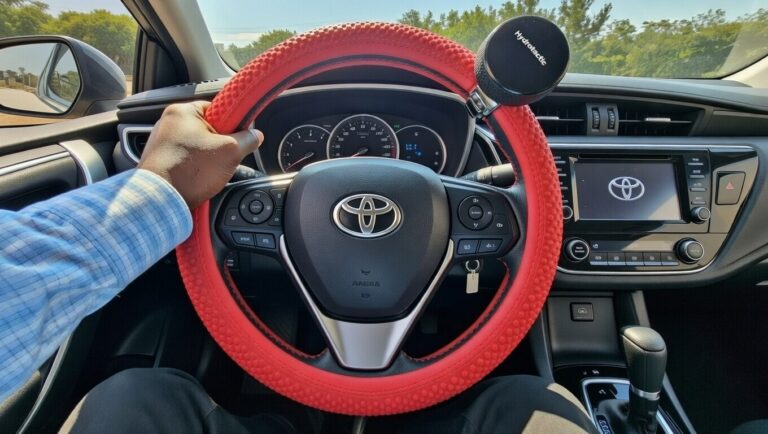
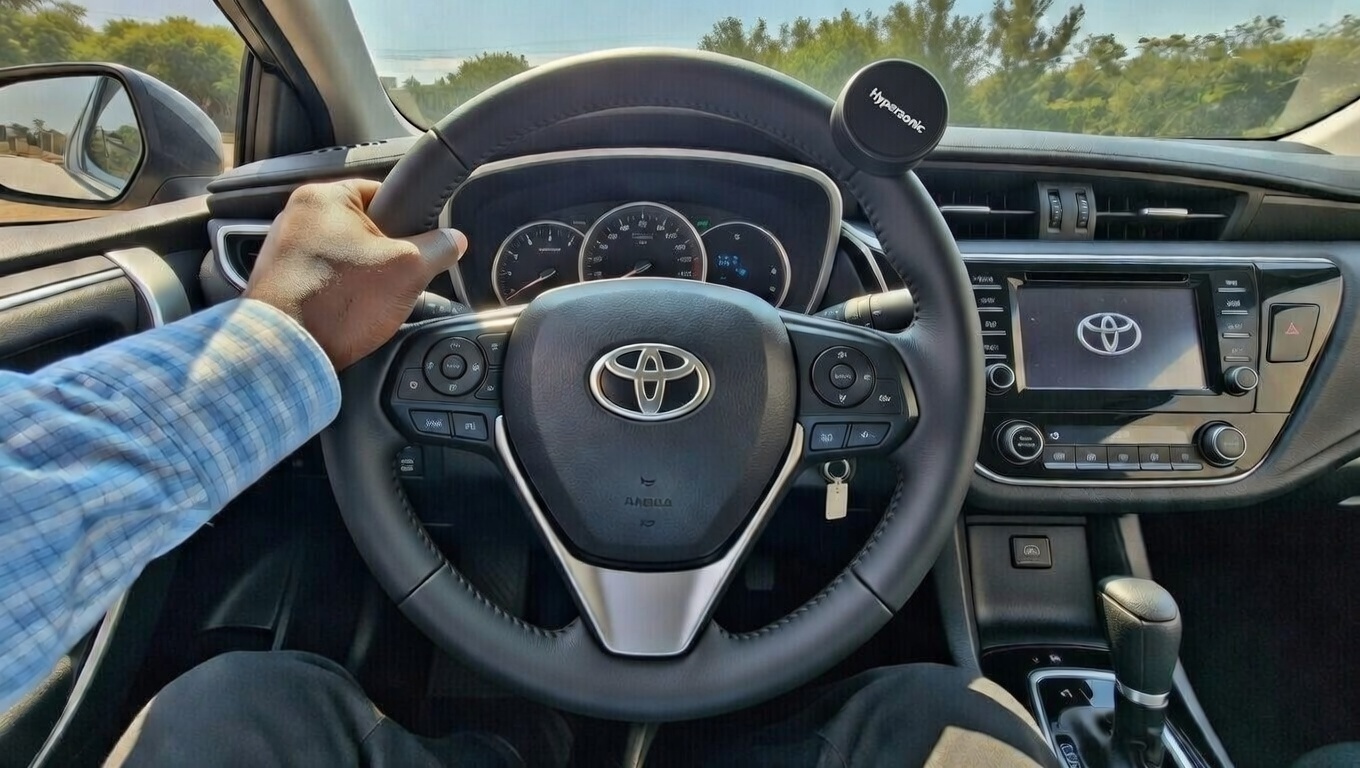
Steering wheel spinner knobs clamp onto the outer rim of the steering wheel. The driver’s airbag is housed in the centre boss of the steering wheel. These are two physically separate areas.
A properly installed spinner knob that sits on the rim does not obstruct, compress, or interfere with the airbag module.
However, there are two real caveats:
- Deployment trajectory. When a driver’s airbag deploys, it inflates outward from the centre boss at speeds exceeding 200mph. If a spinner knob is poorly positioned (e.g. mounted on an inner spoke rather than the outer rim), or if the driver’s hand and arm are positioned awkwardly across the airbag zone at the moment of a collision, the knob could theoretically become a secondary projectile or alter arm position during deployment.
- Aftermarket steering wheels. If someone has replaced their OEM steering wheel with an aftermarket wheel that lacks an airbag, the spinner knob isn’t the safety issue — the missing airbag is.
Practical guidance: Mount the knob on the outer rim of the steering wheel (the standard installation position), ensure it’s clamped securely so it cannot detach under force, and do not modify the steering wheel boss or centre in any way.
Source reference: Airbag deployment mechanics are well documented in Euro NCAP technical papers. (Euro NCAP)
Myth 3: “Your hand can get trapped, and you’ll lose control”
Fact: This is a partial truth that applies to a very specific scenario and is largely user error.
If a driver wraps their fingers through a spinner knob handle (rather than gripping it correctly) and then needs to release the wheel quickly, there could be a momentary delay. This is the same risk as wearing a ring that catches on anything — possible but not a systemic design flaw.
Correct use: The palm rests against the knob, and the fingers grip around it. The hand can release instantly. This is how spinner knobs are taught for use in occupational therapy driving assessments and in commercial vehicle training.
Modern spinner knobs with bearing mechanisms rotate freely, further reducing the risk of catching or trapping because the knob turns independently of the driver’s grip.
Myth 4: “They’re banned because they’re unsafe”
Fact: Steering wheel spinner knobs are not banned in the United Kingdom. There is no legislation under the Road Vehicles (Construction and Use) Regulations 1986, the Road Traffic Act 1988, or any statutory instrument that prohibits their use on road vehicles.
They are also not banned in most of Europe, Australia, or the majority of US states (though some states have restrictions for non-disabled drivers — a legacy of the pre-power-steering era).
In fact, they are actively prescribed as driving aids by Mobility Assessment Centres and occupational therapists under the Motability scheme and via the Queen Elizabeth Foundation (QEF) and similar assessment providers.
A device prescribed by medical professionals and approved for use on publicly funded adapted vehicles is not considered inherently unsafe by UK authorities.
Source reference: Driving Mobility — the national network of driving assessment centres — includes steering aids, such as spinner knobs, among the standard prescribed adaptations. (Driving Mobility)
Myth 5: “They encourage one-handed driving, which is dangerous”
Fact: This is a philosophical argument rather than an evidence-based one, and it assumes something important: that two-handed driving is always happening in practice.
The Highway Code states that drivers should maintain proper control of the vehicle at all times. It does not mandate a specific hand position or require two hands on the wheel at every moment. Changing gears, operating indicators, and adjusting mirrors — all require temporarily removing one hand from the wheel.
For drivers with a physical condition that limits the use of one arm or hand, a spinner knob doesn’t encourage one-handed driving. It enables driving at all. The alternative isn’t two-handed driving — it’s not driving.
For able-bodied drivers, a spinner knob provides additional control options, particularly during manoeuvres requiring large steering inputs (parking, tight turns, reversing). Whether the driver also maintains a second hand on the wheel during straight-line driving is a matter of driving practice, not a flaw of the device.
Myth 6: “The knob can fly off and become a projectile in a crash”
Fact: This is physically possible with a poorly installed, cheap clamp on a dirty steering wheel. It is not a realistic risk with a properly installed quality product.
Steering wheel spinner knobs attach via a clamp mechanism (typically a screw-tightened U-clamp or similar) around the steering wheel rim. When properly tightened onto a clean, dry rim:
- The clamp friction alone withstands normal driving forces easily
- Impact forces in a collision are primarily forward (toward the dashboard/airbag), not centrifugal
- Many quality knobs include rubber or silicone padding inside the clamp, which increases grip on the rim
When this IS a real risk: If the clamp is barely tightened, if it’s mounted on a greasy or wet rim, or if the knob is a very low-quality unit with a weak clamp mechanism. This is a product quality and installation issue, not an inherent design flaw.
Practical guidance: Fully tighten the clamp. Check it periodically (once a month, or when you check your tyre pressures). Use a quality product with a robust clamp. This risk drops to effectively zero.
Myth 7: “Insurance companies consider them a safety risk”
Fact: Most mainstream UK motor insurers do not classify a steering wheel spinner knob as a material modification that affects risk.
The Consumer Insurance (Disclosure and Representations) Act 2012 requires policyholders to take reasonable care not to make misrepresentations. A spinner knob does not alter the vehicle’s performance, engine, suspension, braking, or bodywork. It is a removable accessory clamped to the steering wheel rim.
That said, we always recommend informing your insurer of any modification or accessory, no matter how minor. Most insurers will note it and confirm no change to your premium or terms. If it is a prescribed adaptation for a disability, insurers are very familiar with these aids and typically have a specific process for noting them.
Source reference: The Consumer Insurance (Disclosure and Representations) Act 2012 is available on legislation.gov.uk. (legislation.gov.uk)
When Spinner Knobs Genuinely Are Not Appropriate
We would be doing you a disservice if we pretended spinner knobs are universally perfect for every situation. Honest information builds trust, and there are scenarios where a spinner knob is not the right choice:
Vehicles without power steering
If you drive a vehicle without power steering — certain classic cars, some older Land Rovers, kit cars, or vintage agricultural equipment — the historical kickback risk is real. The knob amplifies the leverage of any sudden steering input, including involuntary ones caused by road surface feedback. Use extreme caution or avoid spinner knobs on genuinely unassisted steering systems.
Driving at very high speeds
At sustained high speeds (motorway driving at 70mph+), fine steering inputs are all that’s needed. A spinner knob is neither necessary nor particularly useful in this context. Most spinner knob users find the device most beneficial at lower speeds during manoeuvring, parking, and urban driving. At higher speeds, a conventional hand position on the rim is generally preferable.
Children or untrained drivers
A spinner knob changes the dynamic of steering input. Someone who is learning to drive should first develop proper steering technique using standard hand positions before introducing any accessory that alters the feel or mechanics of the steering process. There is no reason for a learner driver to use a spinner knob unless it has been prescribed as part of an assessed disability adaptation.
Incorrect installation
A spinner knob that is loose, mounted in the wrong position, or attached with a damaged clamp is a genuine risk. Not because of the product concept, but because a loose object on a steering wheel is a hazard in any form.
What Professional and Medical Bodies Actually Say
The most compelling evidence for spinner knob safety comes from the professional bodies that prescribe and recommend them:
Driving Mobility (UK national driving assessment network) Spinner knobs are among the most commonly prescribed steering aids for drivers assessed through the Driving Mobility centre network. Assessments are conducted by qualified occupational therapists and approved driving instructors who evaluate both the driver and the device for safety (drivingmobility.org.uk)
Motability Operations The Motability scheme — which provides vehicles to disabled people through the Department for Work and Pensions — funds steering adaptations, including spinner knobs as standard. Vehicles adapted under this scheme undergo specific checks and must meet road safety requirements. (motability.co.uk)
Health & Safety Executive (HSE) — Workplace Transport Spinner knobs are standard equipment on forklifts and many industrial vehicles, used in HSE-regulated workplace environments. They are not flagged as hazards in workplace transport safety guidance; rather, they are considered part of the standard control interface. (hse.gov.uk)
British Driving Society and Commercial Vehicle Training Large vehicle driving — HGVs, buses, coaches — frequently involves spinner knobs as standard or optional equipment, used by professionally trained and licenced drivers in demanding on-road environments.
Our Position
We sell steering wheel spinner knobs, so you might expect us to dismiss every safety concern. We haven’t done that.
We’ve acknowledged the historical risks, explained why most of them no longer apply, identified the scenarios where caution is warranted, and cited the professional bodies that prescribe and approve these devices.
A steering wheel spinner knob, properly made and properly fitted to a modern vehicle, is a safe and useful accessory. Millions are in daily use on cars, vans, trucks, forklifts, and tractors worldwide. They are prescribed by medical professionals, permitted by UK law, and accepted by MOT testing stations.
The “suicide knob” nickname belongs to a different era and a different type of vehicle. On a 2025 car with power steering, it’s about as accurate as calling a seatbelt a “restraint hazard.”
Steering Wheel Spinner Knobs: UK Law, MOT & Insurance – The Complete Guide
Frequently Asked Questions
Are steering wheel spinner knobs safe on modern cars? Yes. Modern vehicles with power steering eliminate the primary historical risk (steering kickback). A properly installed spinner knob on the outer rim of the steering wheel does not interfere with the airbag, does not obstruct controls, and provides reliable steering assistance. They are prescribed as medical driving aids by qualified occupational therapists across the UK.
Can a steering wheel spinner knob interfere with the airbag? Not when correctly installed. The spinner knob clamps to the outer rim of the steering wheel. The driver’s airbag deploys from the centre boss. These are separate areas. As long as the knob is on the rim and securely fastened, it does not obstruct airbag deployment.
Why are they called suicide knobs if they’re safe? The name dates to the era before power steering, when steering kickback could cause violent, uncontrolled wheel spin. A spinner knob amplified that force, potentially injuring the driver’s hand or causing loss of control. Power steering made this risk effectively obsolete, but the dramatic name persisted.
Are spinner knobs safe for everyday driving? Yes. They are used daily on millions of vehicles worldwide, including commercial fleets, adapted disability vehicles, and agricultural machinery. There is no published UK data linking spinner knobs to increased accident rates.
Should I worry about the knob coming loose? A quality spinner knob with a properly tightened clamp on a clean steering wheel rim is secure under all normal driving conditions. Check the tightness periodically, just as you would any vehicle accessory. Loose installation is a user error, not a product defect.