Steering Wheel Spinner Knobs for Disabled Drivers in the UK (Complete 2026 Guide)
Table of Contents
Introduction
A steering wheel spinner knob is one of the most commonly prescribed driving adaptations in the UK. It enables one-handed steering and supports drivers with arthritis, limb loss, neurological conditions, and reduced grip strength.
This guide explains:
-
Who needs a steering wheel knob
-
DVLA rules and licence codes
-
Driving Mobility assessments
-
Insurance declaration requirements
-
Motability funding
-
Legal obligations under UK law
-
Progressive condition reassessments
If you are searching for:
-
“Is a steering wheel spinner knob legal in the UK?”
-
“Do I need to tell DVLA about a spinner knob?”
-
“Can I drive one handed legally?”
-
“Will a spinner knob affect my insurance?”
This guide answers everything.
This article does not constitute medical or legal advice. It is an informational guide based on publicly available UK government and charity guidance.
What Is a Steering Wheel Spinner Knob?
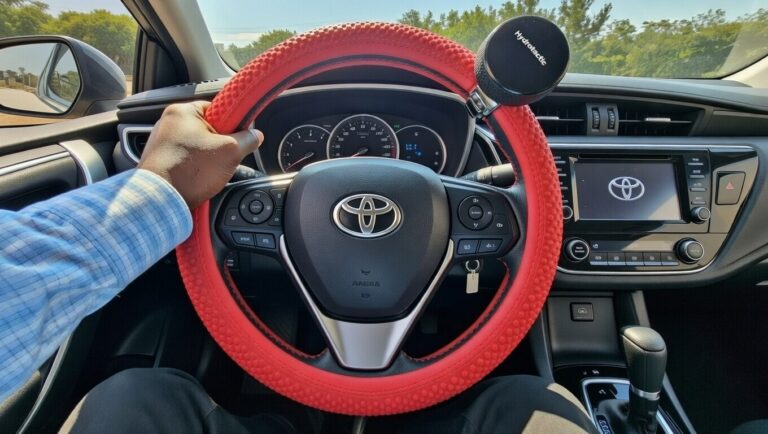
A steering wheel spinner knob (also called a steering wheel ball, suicide knob, or steering aid) is a device that clamps to the steering wheel rim, allowing the wheel to be turned using one hand.
Key Benefits
-
Enables one-handed steering
-
Reduces strain for arthritis sufferers
-
Improves vehicle control for drivers with limited grip
-
Allows secondary control operation with the free hand
-
Supports independence for disabled motorists
Who Needs a Steering Wheel Spinner Knob in the UK?
This section captures long-tail searches like:
-
“Best steering wheel knob for arthritis UK”
-
“Driving after stroke steering aid”
-
“Can amputees drive in the UK?”
-
“Driving with one arm UK rules”
Spinner knobs are commonly prescribed for:
Limb Loss
-
Upper limb amputation
-
Partial hand loss
Neurological Conditions
-
Stroke (hemiplegia)
-
Multiple sclerosis
-
Cerebral palsy
-
Parkinson’s disease
-
Motor neurone disease
-
Spinal cord injury
Musculoskeletal Conditions
-
Osteoarthritis
-
Rheumatoid arthritis
-
Shoulder injuries
-
Severe RSI
Temporary Injuries
-
Arm fractures
-
Post-surgery immobilisation
-
Tendon repair recovery
Any condition that reduces grip strength or coordination may justify a steering aid following assessment.
The Journey from Diagnosis to Driving with an Adaptation
For many people, the process of getting a prescribed steering aid can feel unclear. Here is the typical pathway, step by step.
Step 1: Recognising the Need
The trigger is usually one of:
-
- A new diagnosis (stroke, amputation, neurological condition)
-
- A gradual deterioration in an existing condition (arthritis worsening, MS progression)
-
- A healthcare professional raising the question of driving safety
-
- The driver themselves noticing they’re struggling with the steering wheel
There is no formal threshold that says “you now need a steering aid.” The question is practical: is steering becoming difficult, painful, unreliable, or unsafe?
Step 2: Speaking to Your GP or Consultant
Your GP or hospital consultant can:
-
- Advise on whether your condition is likely to affect your driving
-
- Provide medical evidence if the DVLA requests it later
-
- Refer you to a Driving Mobility assessment centre (though self-referral is also available)
-
- Advise on whether DVLA notification is required
Not all GPs are familiar with the driving assessment process. If your GP is unsure, you can self-refer to Driving Mobility directly.
Step 3: Notifying the DVLA
For most permanent or progressive conditions, the DVLA should be notified. This can be done:
-
- Online at GOV.UK — the DVLA has an online notification tool for medical conditions
-
- By post — using form CG1 (general medical conditions) or condition-specific forms
| DVLA Response | What It Means |
|---|---|
| Licence confirmed unchanged | Your condition does not currently affect your fitness to drive. No action needed. |
| Medical information requested | The DVLA contacts your GP or specialist for a report. Your licence may continue provisionally while this is processed. |
| Driving assessment requested | You are asked to attend a Driving Mobility centre for a practical evaluation. |
| Licence issued with condition codes | You can drive, but only with specified adaptations (e.g. spinner knob, automatic transmission). Codes appear on the back of your licence. |
| Licence revoked | The DVLA determines |
Source: DVLA — Tell DVLA about a medical condition. (GOV.UK)
Important: Notifying the DVLA does not automatically mean losing your licence. The majority of notifications result in the licence being confirmed or issued with condition codes. The DVLA’s purpose is to ensure you can drive safely, not to prevent you from driving.
Step 4: Driving Assessment
Whether requested by the DVLA or self-referred, a driving assessment is the most important step in the process.
Driving Mobility Assessment Centres: The Full Guide
What Is Driving Mobility?
Driving Mobility is a UK charity that operates the national network of driving assessment centres. Each centre is staffed by:
-
- Occupational therapists — who assess your physical and cognitive abilities
-
- Approved driving instructors (ADIs) — who specialise in teaching and assessing disabled drivers
-
- Rehabilitation engineers — at some centres, who advise on vehicle adaptation options
The network covers England, Scotland, Wales, and Northern Ireland with centres located in major cities and regions.
Source: Driving Mobility. (drivingmobility.org.uk)
What Happens at an Assessment?
A typical assessment takes 1.5 to 3 hours depending on the complexity of your needs.
Part 1: Clinical Assessment (Indoors)
The occupational therapist evaluates:
-
- Upper limb function — grip strength (measured with a dynamometer), range of motion in shoulders, elbows, wrists, and fingers
-
- Lower limb function — if relevant to pedal operation
-
- Reaction time — both cognitive and physical response speed
-
- Visual function — field of vision and acuity (they may liaise with your optometrist)
-
- Cognitive function — attention, spatial awareness, decision-making (particularly after stroke or brain injury)
This is not a pass/fail examination. It’s a professional evaluation that determines what you can do, what you need help with, and what adaptations would bridge the gap.
Part 2: Vehicle and Equipment Assessment
You are shown a range of steering aids and adaptations, which may include:
| Adaptation | Description | Typical Use |
|---|---|---|
| Spinner knob (ball type) | Spherical knob on the steering wheel rim | Most common steering aid. Suitable for reduced grip, one-handed driving, arthritis. |
| Spinner knob (T-bar) | Horizontal bar handle on the rim | Alternative for drivers who find the ball uncomfortable or need a different grip angle |
| Tri-pin | Three-pronged device that cups the hand | For drivers with very weak grip who cannot hold a ball knob |
| Palm grip / glove grip | Moulded grip that wraps around the hand | For drivers with no active grip — the hand is held against the wheel |
| Steering ball (different from spinner knob) | A larger ball sometimes with a wrist support | For drivers needing more forearm support during steering |
| Remote steering | Electronic joystick or mini-wheel that replaces the steering wheel | For drivers who cannot use a conventional wheel at all |
| Secondary control relocations | Indicators, lights, wipers moved to a single stalk or satellite pod | For one-handed drivers who cannot reach standard stalks |
The assessor helps you try different options and identifies the combination that gives you the best control with the least fatigue and discomfort.
Part 3: On-Road Driving Assessment
You drive a specially adapted assessment vehicle on public roads with an instructor. This is a real driving experience — junctions, roundabouts, dual carriageways, parking — using the adaptations identified in Part 2.
The instructor assesses:
-
- Vehicle control with the recommended adaptations
-
- Road positioning and observation
-
- Speed management and decision-making
-
- Ability to respond to unexpected situations
Part 4: Report and Recommendations
After the assessment, the centre provides a written report that:
-
- States whether you are fit to drive with adaptations
-
- Lists the specific adaptations recommended (e.g. “steering wheel spinner knob, ball type, fitted at 10 o’clock position, with automatic transmission”)
-
- May include additional recommendations (e.g. refresher driving lessons, reassessment in 12 months for progressive conditions)
This report can be sent to:
-
- The DVLA (to support your licence application or renewal)
-
- Your insurer (as evidence of a prescribed adaptation)
-
- Your vehicle adaptation company (as a specification for fitting)
-
- Motability (if applying for adaptations under the scheme)
How Much Does an Assessment Cost?
OrganisationWhat They Offer
| Driving Mobility | Driving assessment centres, professional evaluation, adaptation recommendations |
| Motability Operations | Vehicle leasing with included insurance and adaptations |
| Motability Foundation | Charitable grants for adaptations and vehicles |
| Disabled Motoring UK | Campaigning, advice, and information for disabled drivers |
| Disability Rights UK | Legal rights, discrimination advice, independent living |
| Rica | Independent consumer research on products for disabled and older people |
| QEF (Queen Elizabeth’s Foundation) | Driving assessment, mobility services, independent living |
Frequently Asked Questions
How do I get a steering wheel spinner knob prescribed? Request a driving assessment through a Driving Mobility centre. The assessment — conducted by an occupational therapist and driving instructor — will determine whether a spinner knob is appropriate for your condition and will provide a written recommendation. This recommendation can be shared with the DVLA, your insurer, and your vehicle adaptation provider.
Do I need a prescription to buy a spinner knob? No. Spinner knobs are available for anyone to purchase without a prescription. However, if your condition requires a spinner knob for safe driving and the DVLA has issued licence condition codes, you are legally required to have one fitted. A driving assessment provides the formal recommendation.
Is a spinner knob the only steering aid available? No. Options include T-bar handles, tri-pins, palm grips, steering balls, and electronic remote steering systems. A Driving Mobility assessment will identify which aid is most suitable for your specific abilities.
How much does a prescribed spinner knob cost? The knob itself typically costs £10–£30 if purchased privately. Through the Motability scheme, the cost is covered as part of your vehicle lease. Driving assessment centres can also advise on sourcing.
Can I drive while waiting for my DVLA assessment? In most cases, yes. The DVLA does not automatically revoke your licence when you notify them of a condition. Your existing licence remains valid until the DVLA makes a decision, unless they specifically inform you otherwise. If in doubt, contact the DVLA drivers’ medical enquiries line on 0300 790 6806.
What happens if my condition gets worse? If your condition is progressive and your current adaptation is no longer sufficient, book a reassessment through Driving Mobility. The assessment will determine whether an alternative or additional adaptation can maintain safe driving, or whether driving is no longer appropriate.
| Type | Typical Cost |
|---|---|
| Standard assessment | £80–£150 |
| Assessment with extended on-road evaluation | £120–£200 |
| Follow-up or reassessment | £60–£100 |
Some centres offer reduced fees for people on certain benefits. The assessment is not available on the NHS, but funding may be available through other routes (see Funding section below).
Centre Locations
Centres are located across the UK. The main centres include:
-
- South East England: Queen Elizabeth’s Foundation (QEF), Leatherhead, Surrey
-
- South West England: Bristol
-
- Midlands: Birmingham (West Midlands), Nottingham
-
- North West England: Manchester / Warrington
-
- North East England: Newcastle / Durham
-
- Yorkshire: Leeds / Wakefield
-
- East Anglia: Norwich
-
- Wales: Cardiff area
-
- Scotland: Edinburgh
-
- Northern Ireland: Belfast
A full list with contact details is available on the Driving Mobility website.
Source: Driving Mobility — Find a centre. (drivingmobility.org.uk/find-a-centre)
Funding Your Steering Aid
A steering wheel spinner knob is one of the most affordable vehicle adaptations available. Purchased privately, most quality spinner knobs cost between £10 and £30. However, funding options exist — particularly for people who need the knob as part of a broader adaptation package.
Motability Scheme
The Motability scheme provides a vehicle — including insurance, breakdown cover, servicing, and tyres — in exchange for your qualifying mobility benefit payment.
Eligibility: You must receive one of:
-
- Enhanced rate of the mobility component of Personal Independence Payment (PIP)
-
- Higher rate mobility component of Disability Living Allowance (DLA)
-
- War Pensioners’ Mobility Supplement (WPMS)
-
- Armed Forces Independence Payment (AFIP)
Adaptations under Motability: Motability funds vehicle adaptations as part of the lease, at no additional cost to you. Steering aids — including spinner knobs — are among the most commonly fitted adaptations. The adaptation is specified in your driving assessment report and fitted by an approved adaptation installer.
If your needs change during the lease, Motability can arrange modification or replacement of adaptations.
Source: Motability Operations. (motability.co.uk)
Motability Charitable Grants
If you’re on the Motability scheme but need adaptations that exceed the standard funding limit, or if you need a more complex adaptation package, the Motability Foundation (formerly Motability — The Charity) may provide a grant.
Grants can cover:
-
- Complex vehicle adaptations
-
- Driving lessons in an adapted vehicle
-
- Deposit contributions for more expensive vehicles needed to accommodate adaptations
Source: Motability Foundation. (motability.org.uk)
Access to Work
If you need a vehicle adaptation (including a spinner knob) specifically to get to and from work, the Department for Work and Pensions’ Access to Work scheme may contribute to the cost.
Access to Work provides grants to cover the additional costs a disabled person faces in employment. Vehicle adaptations for commuting can fall within scope.
Source: Access to Work. (GOV.UK)
NHS and Local Authority Funding
The NHS does not directly fund vehicle adaptations. However:
-
- Some NHS trusts fund driving assessments as part of rehabilitation programmes (particularly after stroke or brain injury)
-
- Some local authority social services departments provide grants or signpost to funding for adaptations that support independent living
-
- Some charitable organisations provide small grants for vehicle adaptations
Purchasing Privately
For a standalone spinner knob without additional adaptations, private purchase is straightforward and affordable. A quality spinner knob costs less than a tank of fuel and can be fitted in minutes.
[Internal Link to: How to Fit a Steering Wheel Spinner Knob — for self-fitting guidance]
DVLA Licence Condition Codes: The Complete Reference
£60–£100
When the DVLA issues or renews a licence with required adaptations, condition codes are printed on the back of the licence. These codes tell you — and any enforcement authority — what adaptations must be fitted for you to drive legally.
Codes Relevant to Steering Aids and Related Adaptations
| Code | Meaning |
|---|---|
| 10 | Modified transmission |
| 15 | Modified clutch |
| 20 | Modified braking systems |
| 25 | Modified accelerator systems |
| 30 | Modified combined braking and accelerator |
| 35 | Modified control layouts |
| 40 | Modified steering |
| 42 | Modified rear-view mirror(s) |
| 43 | Modified driver’s seat |
| 44 | Modifications to motorcycle |
| 45 | Motorcycle with sidecar only |
| 70 | Exchange of licence |
| 71 | Duplicate of licence |
| 78 | Restricted to automatic transmission |
| 79 | Restricted to vehicles conforming to specifications in brackets |
Code 40 is the primary code for spinner knobs. If your assessment recommends a spinner knob as a required adaptation, your licence will carry code 40. You must then have a spinner knob fitted whenever you drive.
Code 78 is frequently paired with code 40 for one-handed drivers, because the remaining hand must stay on the spinner knob at all times rather than releasing to change gear.
Driving without the required adaptation is an offence. If your licence carries code 40 and you drive without a spinner knob fitted, you are technically driving outside the conditions of your licence — equivalent to driving without a valid licence.
Source: DVLA — Information codes that may appear on your driving licence. (GOV.UK)
Your Rights as a Disabled Driver
The Equality Act 2010
The Equality Act 2010 protects disabled people from discrimination in the provision of services. This has practical implications for disabled drivers:
Insurance:
-
- Insurers cannot refuse cover solely because of a disability
-
- Insurers cannot increase premiums solely because of a disability, unless the decision is based on relevant and reasonable actuarial data
-
- Prescribed vehicle adaptations must be accepted; they cannot be used as grounds for refusal or penalty
MOT testing:
-
- MOT testing stations cannot refuse to test an adapted vehicle
-
- Testers must assess the vehicle’s roadworthiness, not the driver’s disability
-
- Prescribed adaptations (including spinner knobs) are not grounds for MOT failure
Driving lessons and tests:
-
- Driving instructors must make reasonable adjustments to accommodate disabled learners
-
- The DVSA must accommodate disabled candidates at the practical driving test
-
- Test centres must be physically accessible
Parking and access:
-
- Blue Badge holders have parking concessions
-
- Adapted vehicles may display relevant signage
Source: Equality Act 2010. (legislation.gov.uk)
Challenging Discrimination
If you believe you have been discriminated against as a disabled driver — whether by an insurer, MOT station, driving school, or any other service provider — you can:
-
- Raise a complaint directly with the service provider
-
- Contact the Equality Advisory Support Service (EASS) for advice — telephone 0808 800 0082
-
- Contact Disability Rights UK for guidance on your options
-
- Seek legal advice if the matter is not resolved
Source: Equality Advisory Support Service (EASS). (equalityadvisoryservice.com)
Insurance for Disabled Drivers with Prescribed Aids
The insurance position for disabled drivers with prescribed adaptations is straightforward in principle:
-
- Declare the adaptation to your insurer
-
- Mention that it is prescribed — this carries more weight than a voluntary fitting
-
- Provide the driving assessment report if requested
-
- Confirm your DVLA licence condition codes — your insurer should have these on file
Most mainstream UK insurers handle prescribed adaptations routinely. Some specialist brokers focus specifically on disabled driver insurance and may offer better terms or more knowledgeable service:
-
- Motability insurance — included in the Motability scheme, covers all prescribed adaptations by default
-
- Specialist disabled driver brokers — some insurance brokers specialise in adapted vehicle cover and understand the full range of adaptations
Your premium should not increase because of a prescribed spinner knob. If it does, question the basis and consider the specialist market.
MOT and Adapted Vehicles
Adapted vehicles undergo standard MOT testing. The key points:
-
- A spinner knob is not a specific MOT inspection item and will not cause a failure
-
- More complex adaptations (hand controls, relocated pedals, modified braking) may interact with MOT-tested systems — ensure your adaptation installer confirms MOT compatibility
-
- The vehicle should be presented for MOT with all prescribed adaptations fitted, as it is driven in normal use
-
- MOT testers encounter adapted vehicles regularly and are familiar with common adaptations
Choosing a Vehicle Adaptation Specialist
For a standalone spinner knob, professional fitting is not usually required — it clamps to the steering wheel rim and can be self-fitted in minutes.
For more complex adaptation packages (spinner knob plus relocated controls, hand controls, left-foot accelerator, or electronic steering), a professional vehicle adaptation specialist is required.
What to Look For in an Adaptation Company
| Criteria | Why It Matters |
|---|---|
| Motability-approved | Approved installers meet quality and safety standards set by Motability Operations |
| Member of a trade body | Membership of organisations such as the British Healthcare Trades Association (BHTA) indicates professional standards |
| Experience with your condition | An installer familiar with stroke adaptations, for example, will understand the full package of modifications typically needed |
| Warranty and aftercare | Adaptations should come with a warranty and the installer should offer ongoing support |
| Proximity to your location | You may need return visits for adjustments, maintenance, or reassessment |
Major UK Vehicle Adaptation Companies
Several companies operate nationally or regionally:
-
- Allied Vehicles — Glasgow-based, one of the UK’s largest adaptation specialists
-
- Brotherwood — Hampshire-based, specialising in wheelchair accessible vehicles
-
- Lewis Reed Group — Midlands-based, covering a wide range of adaptations
-
- Jeff Gosling Hand Controls — specialising in hand control systems
-
- Elap — European manufacturer of hand controls and steering aids
Your Driving Mobility assessment centre can recommend local specialists based on your specific needs.
Progressive Conditions: When to Reassess
If you have a progressive condition — such as multiple sclerosis, Parkinson’s disease, muscular dystrophy, or motor neurone disease — your driving abilities may change over time. A spinner knob that is sufficient today may need to be supplemented or replaced with a different adaptation as the condition progresses.
Signs It May Be Time to Reassess
-
- Increasing fatigue during driving, even short journeys
-
- Noticing your grip strength has decreased since the knob was fitted
-
- Difficulty reaching or operating secondary controls that were previously manageable
-
- Feedback from passengers that your steering seems less controlled
-
- Your occupational therapist or consultant raising concerns about driving
How to Arrange a Reassessment
Contact your nearest Driving Mobility centre to book a reassessment. If you were originally assessed through the DVLA, they may also schedule periodic reviews depending on your condition.
Reassessments follow the same process as initial assessments but are typically shorter, as the assessor already has your baseline data.
What Might Change
| Current Adaptation | Possible Progression |
|---|---|
| Spinner knob (ball type) | Grip too weak to maintain contact |
| Spinner knob + manual gearbox | Unable to release wheel to change gear |
| Spinner knob + standard secondary controls | Unable to reach indicator stalk |
| Any steering aid | Unable to maintain safe vehicle control |
The last point is difficult but important. There may come a point where no adaptation can provide safe vehicle control. A Driving Mobility assessment is the professional, objective way to determine this — and it’s better to make that decision based on expert evaluation than to wait for an incident.
Support Organisations
The following organisations provide information, advice, and support for disabled drivers in the UK:
OrganisationWhat They Offer
| Driving Mobility | Driving assessment centres, professional evaluation, adaptation recommendations |
| Motability Operations | Vehicle leasing with included insurance and adaptations |
| Motability Foundation | Charitable grants for adaptations and vehicles |
| Disabled Motoring UK | Campaigning, advice, and information for disabled drivers |
| Disability Rights UK | Legal rights, discrimination advice, independent living |
| Rica | Independent consumer research on products for disabled and older people |
| QEF (Queen Elizabeth’s Foundation) | Driving assessment, mobility services, independent living |
Frequently Asked Questions
How do I get a steering wheel spinner knob prescribed? Request a driving assessment through a Driving Mobility centre. The assessment — conducted by an occupational therapist and driving instructor — will determine whether a spinner knob is appropriate for your condition and will provide a written recommendation. This recommendation can be shared with the DVLA, your insurer, and your vehicle adaptation provider.
Do I need a prescription to buy a spinner knob? No. Spinner knobs are available for anyone to purchase without a prescription. However, if your condition requires a spinner knob for safe driving and the DVLA has issued licence condition codes, you are legally required to have one fitted. A driving assessment provides the formal recommendation.
Is a spinner knob the only steering aid available? No. Options include T-bar handles, tri-pins, palm grips, steering balls, and electronic remote steering systems. A Driving Mobility assessment will identify which aid is most suitable for your specific abilities.
How much does a prescribed spinner knob cost? The knob itself typically costs £10–£30 if purchased privately. Through the Motability scheme, the cost is covered as part of your vehicle lease. Driving assessment centres can also advise on sourcing.
Can I drive while waiting for my DVLA assessment? In most cases, yes. The DVLA does not automatically revoke your licence when you notify them of a condition. Your existing licence remains valid until the DVLA makes a decision, unless they specifically inform you otherwise. If in doubt, contact the DVLA drivers’ medical enquiries line on 0300 790 6806.
What happens if my condition gets worse? If your condition is progressive and your current adaptation is no longer sufficient, book a reassessment through Driving Mobility. The assessment will determine whether an alternative or additional adaptation can maintain safe driving, or whether driving is no longer appropriate.