Can You Drive One-Handed with a Spinner Knob in the UK?
Whether it’s a permanent condition or a temporary situation, the question comes up more often than most people expect: can you legally drive with one hand in the UK?
Maybe you’ve had a stroke that’s affected one side of your body. Maybe you’ve had an arm amputation. Maybe you’ve broken your wrist, and you’re in a cast for six weeks. Maybe you were born with a limb difference. Or maybe you simply want to know where the law stands.
The direct answer: There is no UK law that requires you to steer with two hands. One-handed driving is legal, provided you can maintain proper control of the vehicle at all times. For permanent conditions affecting one arm or hand, the DVLA may require notification and may add licence condition codes specifying vehicle adaptations — including a steering wheel spinner knob. For temporary conditions, the legal test is the same: can you control the vehicle safely?
This guide covers the law, the DVLA process, how a spinner knob makes one-handed driving safer and easier, and what to do in both permanent and temporary situations.
What the Law Actually Says
The Highway Code
The Highway Code does not contain a rule stating “you must keep both hands on the steering wheel.” This is one of the most common misconceptions in UK motoring.
What the Highway Code does say:
Rule 160: “Once moving, you should… drive or ride with both hands on the wheel or handlebars where possible.”
The key phrase is “where possible.” This is advisory language, not absolute. The Highway Code itself acknowledges that driving with both hands on the wheel at all times is not always possible — gear changes, signalling, adjusting mirrors, and operating secondary controls all require removing a hand from the wheel.
For a driver who physically cannot use both hands, the standard is not “both hands on the wheel” but “proper control of the vehicle.”
Source: The Highway Code — Rule 160. (GOV.UK)
The Road Traffic Act 1988
Section 41D of the Road Traffic Act 1988 (as amended) creates the offence of driving without proper control of the vehicle:
“A person who contravenes a construction and use requirement… as to not driving a motor vehicle in a position which does not give proper control…”
This is supported by Regulation 104 of the Road Vehicles (Construction and Use) Regulations 1986:
“No person shall drive or cause or permit any other person to drive, a motor vehicle on a road if he is in such a position that he cannot have proper control of the vehicle.”
The legal standard is “proper control” — not “two-handed control.”
A driver who maintains proper control of the vehicle using one hand — particularly with the assistance of a steering aid such as a spinner knob — is not in breach of this regulation. The law is concerned with the outcome (control) not the method (number of hands).
Source: Road Traffic Act 1988, Section 41D. (legislation.gov.uk) Source: Road Vehicles (Construction and Use) Regulations 1986, Regulation 104. (legislation.gov.uk)
Permanent One-Handed Driving: The DVLA Process
If a permanent medical condition means you can only drive with one hand, the DVLA has a clear process for assessing and licensing you.
Conditions That May Result in One-Handed Driving
ConditionHow It Affects DrivingUpper limb amputationLoss of one arm or hand entirelyStroke (hemiplegia/hemiparesis)Weakness or paralysis on one side of the body, often affecting one armBrachial plexus injuryNerve damage causing loss of function in one armErb's palsy / birth injuryReduced function in one arm from birthCongenital limb differenceBorn with one arm or with reduced function in one armSevere arthritis in one handOne hand too painful or stiff to grip the wheelPeripheral nerve injuryLoss of grip strength or sensation in one handMultiple sclerosisProgressive weakness affecting one or both armsMotor neurone diseaseProgressive loss of muscle function
Step 1: Notify the DVLA
For any condition that permanently affects your ability to use both arms for driving, you should notify the DVLA. This can be done:
- Online through the DVLA’s medical conditions notification service on GOV.UK
- By post using form CG1 (for general medical conditions) or specific forms for particular conditions
The DVLA will acknowledge your notification and may request further information.
Source: DVLA — Tell DVLA about a medical condition. (GOV.UK)
Step 2: Medical Assessment
The DVLA may:
- Request information from your GP or hospital consultant
- Request you attend a driving assessment at a Driving Mobility centre
- Make a decision based on the medical evidence provided
For most one-handed driving situations, the DVLA is primarily interested in whether you can control the vehicle safely with adaptations, not whether you have full use of both arms.
Step 3: Licence Issued with Condition Codes
If the DVLA determines you can drive safely with adaptations, your licence will be issued (or re-issued) with information codes printed on the back. These codes specify the adaptations required for you to drive legally.
Code 40 (modified steering) is the most directly relevant. If a spinner knob is prescribed as your required steering adaptation, this code will appear on your licence. You are then legally required to have the specified adaptation fitted whenever you drive.
Code 78 or 10 may also apply if the assessment determines you need an automatic vehicle (because your remaining hand must stay on the wheel at all times rather than moving to change gears).
Source: DVLA — Information codes on driving licences. (GOV.UK)
Step 4: Vehicle Adaptation
Once the DVLA has specified the required adaptations, you need to have them fitted to your vehicle. For a spinner knob, this is straightforward — it clamps to the steering wheel rim.
For more complex one-handed driving setups, additional adaptations may include:
- Secondary control adaptations — indicator, lights, wipers, and horn controls relocated to the steering wheel or to a single stalk operable by the steering hand
- Left-foot accelerator — if the right arm is affected and the driver steers with the left hand, the accelerator may need to be moved to the left side
- Automatic transmission — eliminates the need for a gear-change hand
Driving Assessments for One-Handed Drivers
A driving assessment through the Driving Mobility network is one of the most valuable steps a one-handed driver can take. Even if the DVLA doesn’t require it, a voluntary assessment provides:
What the Assessment Covers for One-Handed Driving
- Physical assessment — range of motion, grip strength, reaction time, and ability to reach all controls with the functional hand
- Steering assessment — testing different spinner knob positions and types to find the one that gives maximum control with minimum fatigue
- Secondary controls assessment — evaluating whether you can safely operate indicators, lights, wipers, horn, and handbrake while maintaining steering control
- On-road driving — a real drive on public roads with an instructor, testing the recommended adaptations in traffic, at junctions, on roundabouts, and during parking
- Written recommendations — a formal report specifying exactly which adaptations are needed, which the DVLA and insurers will accept as professional evidence
Why It Matters
The assessment isn’t a test you pass or fail. It’s an evaluation that identifies the best setup for your specific abilities. Two people with the same condition may receive different recommendations based on their individual strengths, range of motion, and driving experience.
The assessors are occupational therapists and approved driving instructors who specialise in this field. Their recommendations carry weight with the DVLA, insurers, and vehicle adaptation companies.
Assessment centres are located across the UK and self-referral is available. You do not need a GP or DVLA referral to book.
Source: Driving Mobility. (drivingmobility.org.uk)
How a Spinner Knob Enables One-Handed Driving
For a two-handed driver, a spinner knob is a convenience. For a one-handed driver, it’s a fundamental control device. The distinction matters.
Without a Spinner Knob (One-Handed)
Steering with one hand on a bare steering wheel rim creates several problems:
- Full-lock turns are extremely difficult. The hand must slide around the rim, losing grip and repositioning repeatedly. In a tight parking space or junction, this can mean multiple grip-slide-regrip cycles to complete one full rotation.
- The hand can lose contact with the wheel. During fast steering inputs (emergency avoidance, roundabout entry), the hand may slide on the rim and momentarily lose directional control.
- Fatigue accumulates rapidly. The hand and forearm are working continuously with no assistance from the second hand. Over a long drive, grip strength deteriorates.
- Secondary controls become harder to access. Reaching for the indicator stalk means completely releasing the wheel. With no second hand to hold it, the wheel may self-centre or drift.
With a Spinner Knob (One-Handed)
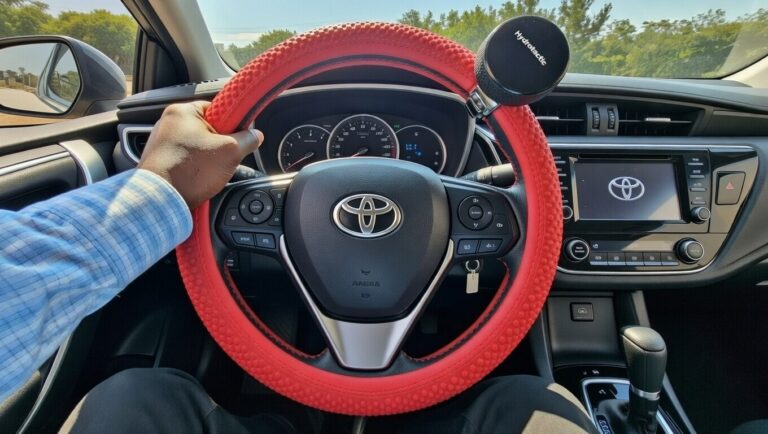
- Full-lock turns are completed in one continuous motion. The hand stays on the knob and pushes or pulls it through the full rotation. No sliding, no regripping.
- Contact is constant. The palm rests against the knob. There is no moment when the hand is off the wheel.
- Effort is reduced. The knob provides a fixed leverage point. Mechanical advantage means less total force per degree of rotation.
- Brief release is safer. If the driver momentarily releases the knob to operate a secondary control, the knob serves as a fixed reference point to return to instantly. Finding a comfortable position on a bare rim takes longer.
A spinner knob doesn’t just help one-handed driving. For many one-handed drivers, it makes it possible.
Temporary One-Handed Driving
Not everyone who drives one-handed has a permanent condition. Temporary situations include:
- Broken arm or wrist (typically 4–8 weeks in a cast)
- Shoulder surgery recovery (often several weeks of limited use)
- Hand surgery (post-operative immobilisation)
- Soft tissue injury (sprains, dislocations, tendon repairs)
- Temporary nerve damage (some recover over weeks or months)
The Legal Position for Temporary Conditions
The legal standard is identical whether the condition is temporary or permanent: you must be able to maintain proper control of the vehicle.
If a broken arm means you genuinely cannot steer safely — even with a spinner knob — you should not drive until you can. No law specifically prohibits driving with a broken arm, but if your driving is impaired and you cause an accident, you could be prosecuted for driving without proper control under Regulation 104.
Do You Need to Tell the DVLA About a Temporary Condition?
The DVLA’s guidance states:
“You must tell DVLA about a medical condition that affects your driving.”
For short-term conditions that will fully resolve, the DVLA generally does not need to be notified, provided:
- You do not drive while your control is impaired
- You resume driving only when you can control the vehicle safely
- The condition does not persist beyond what was expected
If a “temporary” condition persists — for example, a nerve injury that doesn’t recover as expected — it becomes a potentially notifiable condition.
The practical guidance: If you’re in a cast for six weeks and don’t drive during that time, DVLA notification is not necessary. If you want to continue driving during recovery using a spinner knob and your remaining hand, make an honest assessment of whether you have proper control. If in doubt, don’t drive.
Do You Need to Tell Your Insurance?
If you’re driving with a temporary injury, your insurer does not typically need to be notified about the injury itself — provided your licence remains valid and you’re driving within its conditions.
However, if you fit a spinner knob to the vehicle to help during recovery, the same modification disclosure guidance applies as in any other situation.
The Driving Test with One Hand
A question that comes up for younger drivers or those who acquire a condition before passing their test: can you take the UK driving test one-handed?
Yes. The DVSA (which administers the practical driving test) accommodates disabled candidates, including those who drive with one hand.
You will need:
- A vehicle adapted for your needs — this may include a spinner knob, automatic transmission, and any other prescribed adaptations
- Evidence of required adaptations — if the DVLA has issued your provisional licence with condition codes, the vehicle must meet those conditions
- A driving instructor experienced with adaptations — many approved driving instructors (ADIs) specialise in teaching disabled learners. Driving Mobility assessment centres can recommend local instructors.
The test itself is the same standard as for any candidate. The examiner assesses vehicle control, road positioning, observation, and decision-making. The method of achieving that control — one hand, two hands, adapted controls — is not a factor in the assessment.
Source: DVSA — Disabled drivers and the driving test. (GOV.UK)
Secondary Controls: The Other Challenge
Steering is the primary concern, but one-handed driving also means operating secondary controls with limited capacity. When one hand is on the spinner knob, how do you:
Operate the Indicator Stalk?
On most UK vehicles, the indicator stalk is on the left of the steering column. If you steer with your right hand (common in right-hand drive vehicles), the left indicator stalk is on the far side and requires releasing the wheel.
Solutions:
- Brief release and return. Many one-handed drivers become proficient at quickly flicking the indicator and returning to the knob. At straight-line cruising speeds, a momentary release is manageable.
- Relocated secondary controls. For permanent one-handed drivers, secondary controls can be moved to a single stalk or a satellite pod mounted on the steering wheel itself, operable by the steering hand without releasing the knob.
- Steering column-mounted controls. Some adaptation companies fit a ring or paddle on the steering column that allows indicator and wiper operation with the steering hand.
Operate the Handbrake?
The traditional pull handbrake is on the left in UK vehicles. Electronic parking brakes (a button) are increasingly common and easier to operate one-handed.
For vehicles with a manual handbrake, a one-handed driver must release the spinner knob, apply the handbrake, and return to the knob. This is only done when the vehicle is stationary, so there is no steering control issue.
Sound the Horn?
The horn is typically on the steering wheel centre boss or on the spoke. With a spinner knob fitted on the rim, the steering hand can reach the horn pad without fully releasing the knob — particularly if the knob is at the 10 or 2 o’clock position, where the palm is close to the spoke junction.
Change Gear?
For permanent one-handed drivers, an automatic gearbox is strongly recommended — and often required by the DVLA via licence code 78 or 10. This eliminates the need to release the wheel for gear changes entirely.
For temporary situations in a manual vehicle, some drivers manage gear changes at low risk moments (straight road, low speed) by briefly releasing the wheel. This is a personal risk assessment. If it feels unsafe, don’t drive a manual until you have both hands available or switch to an automatic.
Choosing the Right Spinner Knob for One-Handed Driving
When a spinner knob is your primary and only steering control, the choice of knob matters more than it does for a two-handed driver who uses the knob as an assist.
Insurance for One-Handed Drivers
If you drive one-handed due to a permanent condition:
- Your insurer must be informed of the condition and any DVLA licence restriction codes
- Declare any vehicle adaptations, including the spinner knob
- Prescribed adaptations are accepted by all mainstream UK insurers
- Under the Equality Act 2010, insurers cannot refuse cover or increase premiums solely because of a disability, unless the decision is based on relevant actuarial data
If you drive one-handed due to a temporary condition:
- Your licence remains valid (assuming DVLA notification isn’t required for the temporary condition)
- Declare the spinner knob as a minor modification if you fit one during recovery
- Inform your insurer if your driving ability is significantly impaired — this is part of your duty to take reasonable care not to misrepresent your circumstances
MOT and One-Handed Driving Adaptations
A spinner knob fitted for one-handed driving is subject to the same MOT position as any other spinner knob: it is not a specific MOT inspection item and will not cause a failure when properly installed.
If you have additional adaptations — relocated controls, left-foot accelerator, modified braking — these may interact with MOT-tested systems. Ensure your adaptation installer confirms MOT compatibility for any modification beyond a simple spinner knob.
Frequently Asked Questions
Is it legal to drive with one hand in the UK? Yes. No UK law requires two hands on the steering wheel. The legal standard is proper control of the vehicle, not a specific hand position. One-handed driving with appropriate aids, such as a spinner knob, is legal and common among drivers with permanent and temporary conditions.
Do I need to tell the DVLA if I can only use one hand? If it’s a permanent condition, yes — notify the DVLA. They may issue your licence with condition codes specifying required adaptations. If it’s a temporary condition that will fully resolve, and you don’t drive while impaired, DVLA notification is generally not required.
Can I take my driving test with one hand? Yes. The DVSA accommodates disabled candidates. Your vehicle must be adapted to meet any DVLA licence condition codes, and you’ll be assessed to the same standard as any other candidate. The method of control is not a factor — the quality of control is.
What DVLA licence code covers a steering wheel spinner knob? Code 40 (modified steering) is the most common code applied when a spinner knob is a prescribed adaptation. Code 78 (automatic transmission only) may also be applied if the assessment determines that both hands cannot be on the wheel, and gear changes cannot be made safely.
Is a spinner knob enough for one-handed driving? For many one-handed drivers, a spinner knob combined with an automatic gearbox is sufficient for safe, comfortable driving. For more complex needs — severely limited reach, inability to access secondary controls — additional adaptations may be required. A Driving Mobility assessment will determine what you need.
Can I drive with a broken arm? There is no specific law against it, but you must be able to control the vehicle safely. If a broken arm means you cannot steer, brake, or operate controls adequately, you should not drive until you’ve recovered sufficiently. If you can drive safely with one hand and optionally a spinner knob, you may do so — but make an honest assessment.