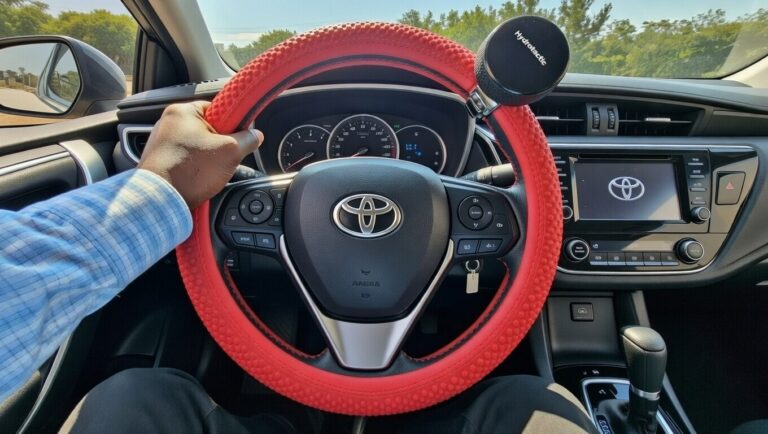
Are Steering Wheel Spinner Knobs Legal in the UK?

Yes. Steering wheel spinner knobs are legal in the UK. No UK legislation specifically prohibits fitting or using a spinner knob (also called a brodie knob or suicide knob) on a vehicle driven on public roads.
However, that one-word answer hides an important detail. UK law doesn’t mention spinner knobs by name — which means legality depends on how they interact with broader vehicle construction regulations, how they affect your control of the vehicle, and whether you’ve told your insurer about the modification.
This guide breaks down the actual legislation, what could make a legal spinner knob illegal, and the specific protections in place for disabled drivers who rely on steering aids.
What UK Law Actually Says About Steering Wheel Modifications
There is no single “spinner knob law” in the UK. Instead, steering wheel accessories fall under the general framework that governs how vehicles must be constructed, maintained, and driven.
Three pieces of legislation are relevant:
1. The Road Vehicles (Construction and Use) Regulations 1986
This is the primary legislation governing vehicle modifications in the UK.
Regulation 104 states:
“No person shall use or cause or permit to be used on a road a motor vehicle or trailer… unless the steering gear thereof is maintained in good and efficient working order and is properly adjusted.”
Source: The Road Vehicles (Construction and Use) Regulations 1986, Regulation 104
A spinner knob does not alter the steering gear itself. It attaches to the outer rim of the steering wheel. As long as the steering mechanism remains in good working order and properly adjusted, a spinner knob does not breach Regulation 104.
Regulation 100 covers the broader construction requirements for steering:
The steering gear must be “designed and constructed so that the vehicle can be steered safely.”
Source: The Road Vehicles (Construction and Use) Regulations 1986, Regulation 100
Again, a properly fitted spinner knob does not compromise the fundamental design of the steering system. It adds a contact point to the existing wheel.
Key point: The Construction and Use Regulations regulate the steering mechanism. A spinner knob is an accessory attached to the wheel rim. These are not the same thing. No regulation within this statutory instrument prohibits accessories attached to the steering wheel, provided they don’t interfere with the safe operation of the steering system.
2. The Highway Code
The Highway Code doesn’t mention spinner knobs, brodie knobs, or steering wheel accessories.
The most relevant rule is Rule 97, which states:
“Before setting off you should ensure that… your seat, headrest, seatbelt and mirrors are adjusted correctly” and that you are in “full control of the vehicle at all times.”
Source: The Highway Code, Rule 97 — GOV.UK
Rule 97 is about the driver maintaining proper control. A spinner knob that helps you maintain control — as it’s designed to do — supports rather than contradicts this rule. A spinner knob that is poorly fitted, loose, or positioned where it interferes with your grip or indicator stalk could undermine your compliance with Rule 97.
The Highway Code also isn’t primary legislation. Failure to follow it doesn’t automatically mean you’ve broken the law, but it can be used as evidence in court to establish negligence or careless driving.
3. The Road Traffic Act 1988
Section 3 defines careless driving:
“If a person drives a mechanically propelled vehicle on a road or other public place without due care and attention, or without reasonable consideration for other persons using the road or place, he is guilty of an offence.”
Source: Road Traffic Act 1988, Section 3
This is the provision that could theoretically apply if a spinner knob caused or contributed to an accident — not because the knob itself is illegal, but because the driver failed to maintain proper control. The knob would be circumstantial evidence, not the offence itself.
So Why Do People Think They’re Illegal?
Three reasons:
The “Suicide Knob” Name
The slang term “suicide knob” creates an immediate negative association. It originates from the era before power steering, when a spinning knob on a heavy steering wheel could catch a driver’s hand or wrist and cause injury. The name stuck. The risk largely didn’t — power steering eliminated the forces that made early spinner knobs genuinely dangerous.
Confusion With US State Laws
Several US states do explicitly ban spinner knobs for non-disabled drivers. Washington State, for example, prohibits them under RCW 46.37.375 unless the driver has a physical disability. Many online discussions about spinner knob legality reference American law without specifying jurisdiction. UK readers absorb the conclusion (“they’re illegal”) without recognising it doesn’t apply here.
Forum Speculation
Search for “are spinner knobs legal” and you’ll find forum threads full of conflicting anecdotal claims. Someone’s mate failed an MOT because of one. Someone else was told by a police officer to remove theirs. These stories may be true — individual MOT testers and police officers can be wrong — but they don’t reflect what the legislation actually says.
This article exists specifically because the current search results for this question are inadequate. The law isn’t ambiguous here. It just hasn’t been clearly stated in one place until now.
When a Steering Wheel Spinner Knob Could Become a Legal Problem
Legal doesn’t mean unconditional. Here are the situations where a perfectly legal spinner knob creates genuine legal risk:
Loose or Poorly Fitted
A detachable spinner knob while driving is a hazard. If it falls into the footwell and jams under a pedal, you’ve lost braking or acceleration control. If it comes off during a manoeuvre, you’ve lost your grip point mid-turn.
Under the Construction and Use Regulations, this could constitute a failure to maintain the steering system in “good and efficient working order.” Under the Road Traffic Act, it could evidence careless driving.
Mitigation: Fit it properly. Check it regularly. Use a knob designed for your wheel diameter.
Interfering With Controls
If a spinner knob is positioned where it blocks the indicator stalk, the wiper stalk, or the airbag module, it creates a secondary problem. You’re not breaking the law by having the knob — you’re breaking the law by being unable to signal or by compromising a safety system.
Mitigation: Position the knob between the 7 o’clock and 11 o’clock positions on the wheel. Avoid mounting directly over the airbag cover or in line with any stalk.
Contributing to an Accident
If you crash and it can be shown that the spinner knob contributed — because it snagged your clothing, because it was loose, because you couldn’t execute a manoeuvre safely — the knob becomes evidence in a careless or dangerous driving prosecution. The knob itself wasn’t illegal. The driving was.
This is the same legal principle that applies to any accessory, modification, or in-car distraction. The object isn’t banned. The consequences of its misuse fall under existing driving offences.
Steering Wheel Spinner Knobs and the MOT Test
A steering wheel spinner knob is not listed as a reason for rejection in the DVSA’s MOT Inspection Manual.
The MOT tests the steering system under Section 2: Steering. The inspection items include:
- Steering wheel condition and security
- Steering column and shaft
- Steering rack and mechanism
- Power steering operation
- Steering joints and linkages
Source: MOT Inspection Manual: Steering — GOV.UK
The manual assesses whether the steering system functions correctly. A spinner knob attached to the wheel rim does not modify any component that the MOT tests.
However, if a tester believes a spinner knob is loose enough to detach and create a hazard, they could note it as an advisory or, in extreme cases, argue it compromises the steering wheel’s condition. This would be unusual and arguably an overreach of the testing criteria, but it is not impossible.
If you’ve been told your car failed its MOT because of a spinner knob, you have the right to appeal. The DVSA operates a formal MOT complaints and appeals process.
Do You Need to Tell Your Insurer?
Yes. You should.
A steering wheel spinner knob is a modification to your vehicle — even though it’s a minor, non-mechanical one. Under the Consumer Insurance (Disclosure and Representations) Act 2012, you have a duty to take reasonable care not to misrepresent your vehicle when taking out or renewing a policy.
Most insurers ask whether your vehicle has been modified from its factory specification. A spinner knob is a modification. It’s a small one. Most insurers won’t adjust your premium. Some won’t even note it. But if you don’t disclose it and later make a claim, the insurer has grounds to investigate whether you misrepresented your vehicle.
The practical risk of claim refusal over an undisclosed spinner knob is low. The cost of a 5-minute phone call to disclose it is zero. Disclose it.
Disabled Drivers: Specific Legal Protections
For drivers with disabilities, steering wheel spinner knobs aren’t just legal accessories — they’re often prescribed mobility aids.
DVLA Driving Assessments
If a medical condition affects your ability to steer, the DVLA may require you to attend a driving assessment at one of the UK’s Mobility Centres. These assessments can result in specific conditions noted on your driving licence — including the requirement to use a steering aid such as a spinner knob.
If your licence specifies a steering aid, driving without it is an offence. The spinner knob goes from “optional accessory” to “legal requirement.”
Source: DVLA Assessing Fitness to Drive — GOV.UK
The Equality Act 2010
Under the Equality Act 2010, disabled people are protected against discrimination. If a service provider — including an MOT testing station or insurance company — refused service or applied disproportionate penalties because of a disability-related vehicle modification, this could constitute disability discrimination.
In practice, this means:
- An MOT station cannot fail your vehicle simply because it has a prescribed steering aid
- An insurer cannot refuse cover solely because you use a disability-related modification
- An employer cannot prohibit a steering aid in a company vehicle if it’s a prescribed medical requirement
Motability Scheme
Vehicles leased through the Motability Scheme can be factory-fitted with steering aids, including spinner knobs, through their adaptation programme. These vehicles pass MOT and are fully insured through the scheme.
If Motability fits them to their own vehicles and insures those vehicles through their own block policy, that’s about as definitive a statement on legality as you’ll find.
What About Commercial Vehicles?
Spinner knobs are widely used in commercial contexts:
- Forklifts — almost universally fitted with spinner knobs as standard
- Agricultural vehicles — tractors routinely use steering knobs for low-speed manoeuvring
- HGVs and delivery vehicles — drivers doing frequent tight turns benefit from spinner knobs
Commercial use is covered by the same Construction and Use Regulations. There is no separate prohibition for commercial vehicles. Health and Safety Executive (HSE) guidance on workplace transport does not prohibit steering knobs and, in the case of forklift trucks, they are considered standard equipment.
Source: HSE Workplace Transport Safety — HSE.gov.uk
Quick Reference: Legality Summary
QuestionAnswerAre spinner knobs banned by UK law?NoIs there a specific regulation prohibiting them?NoDoes the Highway Code mention them?NoCan they fail your MOT?Not as a listed rejection itemShould you tell your insurer?YesCan they be legally required?Yes, if prescribed by DVLA assessmentAre they legal on commercial vehicles?YesCould they contribute to a driving offence?Yes, if they cause loss of vehicle control
Frequently Asked Questions
Is it illegal to drive with a steering wheel spinner knob in the UK?
No. No UK law prohibits steering wheel spinner knobs. They are legal to fit and use on vehicles driven on public roads, provided they don’t interfere with the safe operation of the steering system or the driver’s ability to maintain proper control.
Can a police officer make me remove a spinner knob?
A police officer cannot issue a fixed penalty for having a spinner knob, as there is no offence of “having a spinner knob fitted.” If an officer believed your vehicle was in a dangerous condition — for example, because the knob was loose — they could issue a prohibition notice under Section 69 of the Road Traffic Act 1988, but this would be based on the vehicle’s condition, not the presence of the knob itself.
Are spinner knobs legal for new drivers?
Yes. There is no restriction on spinner knobs for newly qualified drivers. The restrictions that apply to new drivers under the New Drivers Act 1995 relate to penalty point accumulation, not vehicle accessories.
Do I need a disability to use a steering wheel spinner knob legally?
No. Unlike in some US states where spinner knobs are restricted to disabled drivers, the UK imposes no such condition. Any driver can legally fit and use one.
Will fitting a spinner knob void my car’s warranty?
A spinner knob attaches to the steering wheel rim and doesn’t modify any mechanical component. Under the Consumer Rights Act 2015, a manufacturer cannot void an entire vehicle warranty because of an unrelated aftermarket accessory. If a steering problem arose from the knob itself, the warranty claim on the steering system could be disputed — but unrelated warranty coverage should remain intact.
The Bottom Line
Steering wheel spinner knobs are legal in the UK. They always have been. No legislation bans them, the MOT doesn’t test for them, and the Highway Code doesn’t mention them.
What UK law requires is that your steering system works properly and that you maintain full control of your vehicle. A well-fitted spinner knob meets both requirements. A poorly fitted one could undermine them.
Buy a quality knob. Fit it correctly. Tell your insurer. Drive well.
That’s it. That’s the law.